Showing posts with label fat burner. Show all posts

Friday, 13 September 2013

Fat Burner - Part II (I'm a freak)

In November last year, I had a test done.  It was a test to see where I was in terms of how I use fuel during exercise.  The thinking was that I'd like to try to optimise to burn as much fat as possible and as little carbohydrate in order to make race fuelling easier, both in practical terms and in terms of being easy on my poor stomach after the experience I had in Bolton in 2012.

I turned out to be a reasonably good fat burner and I used the numbers to test the theory at the London Ultra in February this year.  Wind forward a good few months and I wanted to see what, if anything, had changed on a diet that had evolved a little to between 50 and 100g carb a day rather than the draconian <50g a day I started with last year.  I was slightly apprehensive that the slipping into very weird habits (eating cake a couple of times a week when I've never been that much of a fan!) and going a bit off the leash on a semi-regular basis since starting a new job in March might have ruined things a bit.


So... this stuff is both simple and complicated at the same time.  You may already know a lot of what I've written below, but here it is just in case.  (Also lots of it is very personal to individual circumstances, genetics etc. and lots of it/almost all of it has not a lot of hard research behind it, but we do the best we can.)

The simple bit is that the "best" way to improve your fat burning capability is in a gentle and controlled way. Just go out and run/cycle.  Even with all the technical information in the world at your disposal, there is nowhere near even 1% of the information we'd need to get this sort of thing absolutely right without some empirical, individual experimentation.  i.e. go out and do longer and longer runs at the target pace, carry emergency nutrition with you, but aim to complete the run without consuming it.  If you hit the wall, obviously eat/drink.  Take note of the results.

The complicated bit...

In general:-

  • When exercising, your body will use a mixture of fat and carbohydrate to fuel the effort.  The ratio varies with effort level.
  • Untrained endurance athletes will rely quite a lot on carbohydrates for fuel and the mass-market advice to consume 20g carb every 30 mins (or whatever it is) is a good safety net to avoid bonking/hitting the wall.
  • Untrained, not highly-dedicated fat burners will have a secondary problem to the physical wall in the mental wall too which is also physiological in root as it relates to what fuel your brain is using.
  • The human body contains approximately 2000kcals (varies mainly by body weight) of accessible glycogen (metabolic by-product of carbohydrate which the body uses for fuel, and more slowly generated from protein if there's insufficient carb available).
  • There is a hardwired limit for people that does not allow glycogen depletion beyond a certain level - i.e. some people can deplete to 20% remaining, rarely down to 5-6%, some are less lucky.
  • There are two or three points in the heart rate range where the ratio of fat to carb dramatically changes.
  • There is a point at which the effort level is so high that a body is using 100% carbohydrate to fuel the effort.
  • Taking in carbohydrate replenishes glycogen stores, but it takes a little while to process (20+ minutes depending roughly on GI)
  • Taking in protein replenishes glycogen stores but much much much more slowly than carbs.

Most of these factors may be altered through nutrition and training.  The "may" is more than likely genetic and there's not a lot of info about on the likelihood of whether a person may be able to alter the factors, but it appears that the majority of people who end up in elite/professional sport are able to and do do so to some extent or more.

The effort level for a given ratio of fat to carb can be altered/improved by any or a combination of these things over a period of months:-


  • Fasted exercise sessions - e.g. do a morning run before you have breakfast.
  • Add a little caffeine into your daily routine; can be very effective in combination with the above point.
  • Change your general nutrition plan to keep the amount of carbohydrates low or very low (the absolute threshold will vary from person to person.  For example, I seem to be able to "get away with" around 100g carbs a day, whereas some seem to need to keep below 20-30g a day.
  • Change your general nutrition plan to keep the amount of fat in your diet high or very high. Again the percentage will vary from person to person, but I hover around the 70-80% range.

From personal experience, I have found the first and last points to be the most effective in moving the thresholds in the right direction for me.

If you are particularly keen to switch your brain fuel from glycogen to ketones (i.e. from carbs to fat) you would have to be very very harsh with carb restriction; usually under 30g a day for around a week or so; during this time you're likely to feel fuzzy in the head, irritable and need more salt than usual.  The general effect of switching brain fuel is twofold: you reduce the impact on your emotional wellbeing when you do push hard and run out of glycogen, and secondarily it appears that you may be able to then access more of your body's glycogen stores and deplete them even more than usual when your brain runs on ketones.  Again, from personal experience I have bonked on a very low carb diet (after 6 days training camp, doing approx 8 hours training per day) and instead of wanting to sit in a corner and cry, I just couldn't get my legs to go at the speed I wanted them to, no pain or distress, they just refused to go quickly.  A much less stressful result.

If you have the time, spare cash (around £165) and/or inclination, you can get a test done, like I did, that gives you an idea of the ratios of fuel you personally burn and at what effort level the ratios change appreciably.  It's called a "gas analysis test" or "metabolic efficiency test" and the test is done on a bike or treadmill while strapped into a mask over your mouth and nose.  You start off at an easy pace for a warm up, then the recording starts of your heart rate, pace/wattage and the amount of air going in and the volumes of CO2 coming out.  The effort level gets increased every few minutes in steps to a reasonably hard level but not absolute maximum (this is not a "max test") and then the data collated and analysed.  You can then do some calculations on how long and at what effort you could safely run without needing to top up the stores and if you do need/want to top up you can work out how much and how often.  This is what I did for my 50km Ultra race in February and I calculated that at a heart rate of around 160BPM I could conservatively go for 6 hours before I might need to top up.  I ran the race at a HR of around 170BPM in 05:50 and kept pace the whole way around, no sign of legs ignoring me.  Oh, and I didn't eat anything at all, despite well-stocked aid stations full of goodies!

Now in the test last month, the numbers went in a good direction even further.


I'm burning 100% fat right up to a heart rate of 165BPM (on the bike) now.  That's 87% of my max heart rate (on the bike).  That's pretty phenomenal.  In theory, as long as I keep my heart rate under 165BPM, I could ride pretty much forever on my stores of body fat and not need to eat anything at all.  Apparently, this is fairly uncommon.  What's also uncommon is not switching fully to carb burning at high effort output - known as "going anaerobic".

The additionally interesting bit comes from the carb burn and how that varies, as that will tell me ballpark rates at which I get through my body's stores of glycogen and then at what rate I would need to replace them at in order to maintain that level of output.

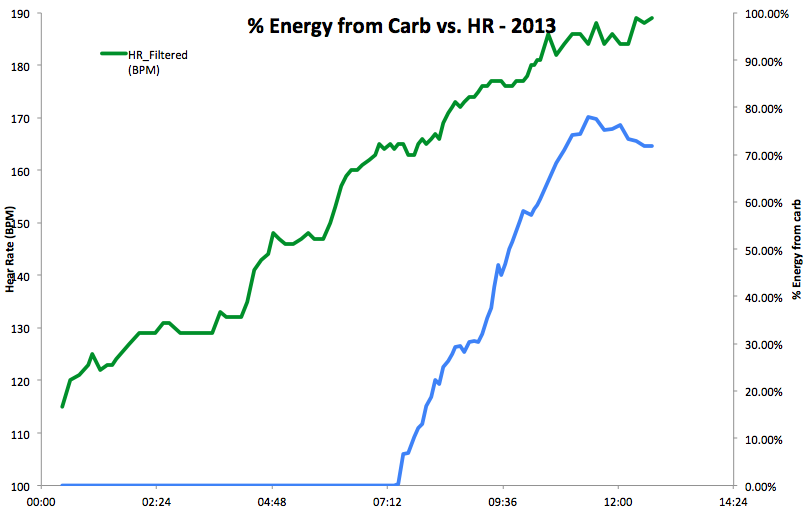


OK, so the graphs aren't useful for working that out, but the numbers are and the headlines are:-

How long I have on stored glycogen (conservatively)
How much carb/hour I need to refuel, after running out of glycogen

So... in practical terms, what I'm normally doing now is eating my usual low carb/high fat diet right up until the morning of a race.  On that morning, I'll have a breakfast (3-4 hours before the race, so if an afternoon one, then adjust the time to match) of scrambled eggs, with avocado and cream cheese, or cured meats with boiled eggs and cheese, with a mug of tea - very my normal breakfast! During the race, I'll have water with electrolytes and that's pretty much it.  On a very much longer session/race I'll take something if I think I might just get hungry (cheese/nuts/cured sausage) and a fuel bar or two for emergencies (something like a Clif bar).  I raced a half ironman a couple of weeks ago and ate nothing apart from one speculative gel at the start of the run course, because I hadn't gone through the new data properly yet - turns out I didn't need it (lots of analysis around pace and heart rate during the race confirms that well enough for me to be happy with that).  And I raced pretty hard, so I'll take that as an encouraging data point for me.

What I'd say, to others who want to take steps into this stuff, is that if you have a few months to try things, do that and see how things feel - don't be afraid to add in a bit more carb on the day of the race, your body will use it unless you're pretty much walking the whole thing or are very very highly trained and run very slowly for your ability.  If you don't have a lot of time, I'd say have a normal breakfast on the day of a (longer) race and if you feel you want the safety net during a (longer) race, try something more natural with minimal sugars, or even home-made fuel bars where you can control the ingredients to things you know are fine for you.

For me... this all means I can experiment a bit and play it pretty fast and loose with taking on carbs during higher effort training and racing.  I've heard a number of accounts that state that once you're actually exercising, you don't suffer the usual difficulties related to insulin responses to carbohydrate , though there are some that say you need to be careful as if you do stimulate high insulin response it will interfere with your fat burning capability during the exercise.

At the end of the test, looking at the initial numbers, the tester summarised with "Endurance. The longer the better. You will have a phenomenal advantage."  Along with "Those results border on the freakish, I've rarely seen anything more extreme."  *beam*

Monday, 18 February 2013

London Ultra (race report)

(I've done a brief report on the low carb/high fat thoughts for the race here - this is the fluffy race report)

6am on Sunday 17th February 2013 and I'm waking up to a day with the longest run of my life so far, having run further than 21km only twice before this day.  And today I'd be running 51km.

MrTOTKat (on race support duty) and I got up and breakfasted on scrambled eggs, smoked salmon, baby plum tomatoes, coffee and cream before packing water bottles, post-race clothes and shoes into the car and off to pick up @abradypus and head to the race start near Grove Park station in East London.  At 7am on a Sunday, traffic is pretty OK crossing town from South West to South East and we made good time, arriving at registration at 5minutes to 8am despite setting off a few minutes late.

Registration was quick and easy and the room was filled with people munching on chocolates being handed out, bananas and various chewy bars.  Pointy-looking, fit-looking people.  Not like me (or so I think).  It's pretty chilly, so I'm in a few layers: Under Armour base layer with long thumb-hole enabled sleeves and a 1/4 zip, Under Armour long-line compression knickers (both from Sport Pursuit), my old Nike Run To The Beat t-shirt (best running t-shirt ever!), Under Armour fleecy beanie (£8 from T K Maxx :o)), Bridgedale running socks, some lovely warm Thoosa running tights (again from Sport Pursuit), Nike running gloves and a buff from Blacks (own brand, I think, 2x for £10 on sale a while back).  My support kit - a Camelbak Delaney Plus run belt which has 1x closed pouch (holding iPhone and extra battery pack for safety and being able to upload position to GarminFit), 1x mesh pouch (holding "emergency salami" and a middle-warming haramaki in case I got cold), 1x bottle holder (plan was to swap in a bottle at each check point if I felt I needed it).


We stood and chatted for a bit, listened to the race briefing (you really need to look up "tyre girl") before strolling to the start, a wave of the flag by Rory Coleman and we were off.

The plan was to start out at around 07:40 at a nice high cadence to warm up and then turn it up from there to keep my heart rate on or below 170BPM.  OK, I didn't quite do that as that meant falling off the back of the entire field and that would have been too depressing at the start, so I picked up to keep up as the rest of the runners swarmed down the middle of the road and held up a bus for about 5 minutes before thinning enough to fill the pavements without too much problem.

I thought I'd get space to myself pretty early on, but it didn't really happen and  I fell into a bad habit of following people in front of me.  You don't do that.  You can't be sure the people in front are going the right way (and I hear later on from "3 guys in blue" that they did it, ended up 1.5 miles off course before realising, sorting themselves out at the others carried on going the wrong way).  But I did keep an eye on signs and got tuned in to the various combinations of Capital Ring signs on high posts, little logos on low posts, "Ur" stickers and yellow spray-painted arrows that marked almost the whole route (more on the "almost" later).

So, despite not really wanting to talk to people as I generally prefer to run alone, I find that talking uses effort I'd rather spend on the actual running and I either end up running too slowly or too quickly when with others, I ended up running and talking to people.

Bits of London came and went and I recognised parts of the route from having read the Capital Ring leaflets and plotted the course to load onto my Garmin 910 watch (which I had on).  Check-point 1 came up pretty quickly and I took a bottle from MrTOTKat, glugged down half of it, ditched my hat and gloves as they were too much now, and carried on without taking a bottle with me.  On entering Crystal Palace Park I spotted loos and decided it would be a good idea to make use of them and took my leave from Dave-the-teacher who I'd been chatting with to that point.  I spent a bit long in the loo, due to making sure that all of my layers went comfortably back in place without wrinkling, and ended up running alone for quite a while after that.

See the little scribble just inside the East side of the Park? Loos :o)

I don't remember much of the next bit of the route.  There were quite a few sharp little hills and I walked up those to manage my effort level/fuel burn, paranoid that I'd run out of carb and have to slow right down (probably to a walk) before I got to the end of the race, and there were a few odd little bits like where the route wriggled around the back of a kiddies play-park.


Then I overshot a turning by a few metres due to a bus being in a bus stop and obscuring a sign I caught sight of briefly then misplaced where it was...


Very quickly recovered from that and carried on alone for a while longer and up came check-point 2 and MrTOTKat was ready and waiting with a smile on his face, a full bottle in one hand and a half full one in the other.  I think I made a mistake at this point as I put the 1/2 full one in my bottle holder, swigged a bit of the full one and carried on.  I wasn't all that thirsty, so I thought it was OK.  Quite quickly I regretted the bottle I was carrying as it changed the weight distribution that I'd got used to and it tempted me to swig frequently like I used to on long training runs last year.  Not good.


Onwards, still alone, past Tooting Bec Lido and up another mean hill before my Garmin shrieked at me half way down a road I'd been following Capital Ring signs into, with no turnings that I'd spotted, telling me I was now off course.  And it kept at it, so I stopped, turned around and headed back to see if I'd missed a turning, to see "3 guys in blue" (3 of the other runners, dressed in the same blue shorts and tops and apparently running for a testicular cancer charity - Dave, Ian and Nick) thundering towards me.  I asked if I'd gone wrong and they were sure I hadn't, so I carried on with them for a little bit, chatting away before I realised their pace was too high for me and I let them go on ahead without me at Wandsworth Common.


Memory fades again at this point a little until I saw signs for Earlsfield and recognised bits of local territory and I motored on towards Wimbledon Park, through the building site mentioned in the race briefing which meant I was at about the half-way point and on into the park, around the kiddies play-park, alongside the lake and then down the side of the athletics track where I'd set my 5km PB only 4 days earlier.  Check-point 3 hove into view and I chatted to MrTOTKat a bit about my stiffening right quad, sore feet and achey glutes which had come on noticeably since check-point 2, and dropped off my buff as that was making me too warm too now.

Digging the empty bottle out of the holder - attractive pose!

I ditched the empty bottle, drank half of another bottle and went on without a bottle for the next section of the route.  And this next bit of the route was going to be nicely familiar, but I knew it would be muddy and a detour from my usual routes across/around Wimbledon Common.

Brooks Pure Cadence
Asics - Fuji Attack
I did go off course just past the windmill as I missed a low-level Capital Ring sign, but realised really quickly, swore a bit until I saw it and set off down a steepish, muddy descent.  The mud had begun in earnest and this was the section that made me worried about footwear for the previous two days.  Trail shoes?  Road shoes?  I'd plumped for road shoes in the end because most of the course is on pavement, tarmac, gravel or paved paths and my cushioned trail shoes (Asics Fuji Attack) are appreciably heavier than my cushioned road shoes (Brooks Pure Cadence).

The next part of the route across Wimbledon Common and then across the A3 (where I bumped into @abradypus who very kindly stopped me from heading off on totally the wrong heading at the junction) into Richmond Park was very muddy.  Very very muddy bridlepath at the beginning, then once in Richmond Park just a boggy field in which I lost my right shoe right at the first edge of the field, accompanied by a sucking-popping sound from the mud and a loud squeak from me.  From here on in, my already abraded feet were scraped further by the gritty mud that got squeezed into my shoes and socks in this section.  My feet were soaked through and I squelched on through Richmond Park.


I got complacent following a few other runners up the little hill and we all missed a left turn just past Jubilee Plantation.  After a while my Garmin yelled again "off course!" but I couldn't see a path so assumed I'd just plotted the route from the leaflets in a way that disagreed with the signs (which had happened a few times before so far).  But when it got to over 500m off course and we were coming up on one of the park gates I was certain we were all wrong and off course by 1/2km.  We agreed on a route to join the course that seemed sensible (and didn't end up short-cutting) and we all trotted onwards towards the river and the Richmond check-point.

Once alongside the river, it got really really busy; loads of people out for a Sunday afternoon stroll with baby buggies, pushchairs, toddlers in tow, low-slung bicycles, sit-up-and-beg bicycles, scooters, couples strolling hand-in-hand... a normal busy Sunday by the river.  I let the other runners I'd got a bit off course with go on ahead as they were quicker and then we crossed the river again and I was alone.  But I started to overtake people.

Check-point 4, the last checkpoint, 24.5 miles into the 31 miles  and I was sore and it looks like it was showing (though I was slowing to walk when this photo was taken so I could pick up water).  And here I made a big mistake and didn't realise it for a little bit.  I just picked up a half-full bottle of water and ran on with it.


The next stretch was really quiet, long and impossible to get lost on even when it diverged from the river and then dove into Syon Park.

See the line of trees to the right of the red line? That's where the path is...
I had "fun" in Syon Park as I followed the "Ur" stickers along the tarmac road, running on the right as you do when there is no pavement.  There was a little path a good 30-80m from the road at varying distances along its length, but I figured that the stickers were along the road and there was no need to run further than I needed to, so to speak.  The traffic handled it perfectly fine, as it should, until a very angry woman driving in the opposite direction gesticulated at the path and yelled at me to get on the damned path.  I ignored her as long as I could and then cracked and flipped her some Vs.

Under the A4 and down the canal a bit, waving and "good afternoon"ing the boaters along the tow-path, over the river again and overtaking a good few more people who were now walking even on the flat, my legs were really starting to get pretty sore but my feet were drying out, but the worst part was that I got thirsty.  I drank the rest of my water and still had a little way to go.

I realised I'd need to beg for some water from someone else and started to check every bicycle that went by for bottles; there were no other runners in sight.  And then I found someone... who had water and plenty of it left and kindly let me have a drink, then filled half my bottle with it.  I could taste something faint and sweet in the water and asked what was in it.  I feared the answer (it could easily have been a carb mix), so the relief was immense when the answer came "Nuun tablets".  Phew!  No sugar!  I thanked the guy and trotted on as he was walking, but then he started running again and we ended up running together around the massively frustrating paths/bog/quagmire of Brent Lodge Park and then Brent Valley Park and stayed together, chatting along as I counted down the distance still to go.

Frustrating, looping part of the route.
Steve, as was his name, was in quite some discomfort and was grunting with the effort of each step and I joined in occasionally on up or down slopes and steps as my right quad was by now really quite painful.  The OK kind of pain though, the pain of use rather than injury.

Things were really sore now for me too and every time there was a little hump-backed bridge to go over a stream, or steps up or down or a little slope became very difficult.  It was hard to control the descent more than the rise, but the rises were difficult too.  We were so close to the finish and for the first time I had mild thoughts of wanting to walk.  But I wanted to finish in under 6 hours and do as well as I could with the fuel and fitness I had.  Steve and I encouraged each other on in our own ways, his more vocal than mine and I felt so much better after the water he gave me that I ignored the "go on, just walk" thoughts and carried on trotting.

Then we crossed that final road and saw the sign for Perivale Park where the athletics track and the finish line were!  We were so close!  We turned right into some trees and my Garmin announced we'd got to the finish a little prematurely, but we picked up another runner and headed for the track.  Steve ducked in through some more trees to the track and he and the other guy sprinted down the track to the finish, leaving me for dust behind them with nothing left in my legs but I still carried on running and ran over the line.

Me, finishing!
Got a medal and a goodie bag presented to me by Rory Coleman and I triumphantly produced the square of snickers I'd picked up at check-point 4 where I told MrTOTKat I thought I was in serious danger of running out of fuel as I was burning my heart rate too high too often.  It was untouched from check-point 4 and I'd not had to eat it, nor any of the nuts or salami I'd carried with me in case I felt uncomfortably hungry.


I'd done it.  51km on a breakfast of salmon, eggs and tomatoes with coffee and water with electrolytes while on the route.  No gels, bars, sweets, snacks from the check-points, energy drinks, cola or sugar in any form; no food or calories; just water and salts.  I didn't run out of fuel, I ran out of endurance strength/form/support in my legs.  And I felt fine!  Perky!  The lady who massaged my legs said I didn't look tired at all.  51km in less than 6 hours, at an average moving pace of 06:45/km.  3 PBs in 4 days - fastest 5km ever by 91s, fastest 42.2km ever, and longest run ever by 9km.  The only disappointment was lack of hot drinks at the finish and it was quite a big disappointment as I was really looking forward to a cup of tea.

My shoes and feet were caked in gritty mud...


But hey... I had a medal and I'm now an Ultra runner, no matter what people think about the 50km distance.


And thanks to MrTOTKat for making me a yummy dinner (bacon, eggs, tomatoes, cheese and no-carb "bread") that wasn't giving in to the the convenience of a Dominos pizza.  And for the fantastic support through the day, ferrying to and from the race through the awful traffic on the way back and being there at the check points with everything I needed at the right times and words of encouragement and pride.  <3

The results are out and my official time was 5 hours 51 minutes (Garmin which auto-pauses says I was on the move for 5 hours and 41 minutes).  I was 18th lady across the line of 38 that started, 178th across the line of 246 people that started, two didn't finish.

London Ultra (LCHF edition)

(The human, fluffy race report is here, the low-carb report is below.)

So, I've run two half marathons and two more as part of Ironman 70.3 races, and one marathon as part of an Ironman since I started running in July 2009.  I've also got my longest training run of 28km once, but since July 22nd 2012 (Ironman UK 2012) I've not run further than 15.5km in any training runs and only one half marathon race.  Of course it was a great idea to sign up for a 51km Ultra Marathon!

July 2009 - started couch-2-5K
October 2009 - first 10K run/race
September 2011 - first 1/2 marathon
July 2012 - Ironman UK (first/only marathon)
February 2013 - London Ultra

Seems a logical progression, right?

Add in the fact that I changed to a low carbohydrate (high fat) diet at the start of November 2012, and, against conventional sports wisdom, planned to race without loading up on, or taking on carbohydrate during any race as far as is practical and you get a quite interesting place for a 51km long running race course.

I train with water and electrolytes and otherwise just end up eating a little more on training days than rest days, averaging around 2400kcals per day.  And there are a few reasons I want to race without taking on carbohydrates (faff, stomach trouble, personal lack of skill, time-wasting, not being comfortable with the contents of gels/sports drinks/sports bars in general, insulin spikes).  This 50km Ultra race was going to be a fantastic, practical test of the theory of fat-fuelling exercise for me.

In the run up to the London Ultra on Sunday, I decided to work out how long I could run for and at what effort level before I depleted my body's glycogen stores.  I had the gas analysis figures from the beginning of December last year and Excel in my armoury...

Complicated with a lot of assumptions:-
  1. liver glycogen as normal
  2. reduced muscle glycogen stores due to day-to-day diet
  3. using muscle glycogen from mostly lower half of body
  4. lower half muscle mass is 2/3rds of overall muscle mass
  5. weight approx 62kg
  6. body fat of approx 25%
  7. no added carbohydrate from breakfast (4g carb, coming from 100g tomatoes and 40ml double cream)
  8. improved heart rate threshold for changes in fuel burn by approx 5 BPM since gas test


Using those assumptions, the calculations dropped out the rough reckoning of needing to maintain a heart rate of 170BPM to be able to last for 6 hours on the carbohydrate stores from my body (estimated to be 1500kcals from the initial assumptions above and a burn rate of 4.2kcal/min of carbohydrate).  You can see from the graphs and below spreadsheet fragment that the time (Time on CHO column below) drops off a cliff at 166BPM when it was tested (and I'm assuming an improvement of 5BPM in threshold since this test).


Stats from my HR monitor for the race:-
HRavg   - 171
HRmax  - 179

Pretty pleased with my effort management (it's missing the first 15mins due to trouble before the start)
So I kept fairly close to the heart-rate I'd intended.  But, for every beat per minute above 170 I burn around an extra 10kcals in carbs per minute so it starts getting very carb costly very quickly when I go above that number.

To cut the long story short, I had scrambled eggs and smoked salmon with a few cherry tomatoes for breakfast at around 06:30, the race started at 08:59, I finished at 14:50 having had only water with High5 Zero tablets in (and about 300ml water with Nuun tablets in).  I did not bonk.  I maintained a steady 06:45/km throughout (apart from a wee stop and short stops at aid stations and traffic lights).  I maintained an average heart rate of 170BPM.  I did not feel tired.  I was perky at the finish.  The bits of me that hurt was my calves, quads and soles of my feet and I needed to stop when I did because my fitness and muscular endurance levels had limited me (remember, I have -not- trained for anything like this distance in the slightest), not my fuel.

Endurance racing without carb loading or taking on carbs in a race is possible.  It isn't painful or difficult.  Fat adaptation works.

And I want to try this again but with race-specific training and better long distance fitness (i.e. able to run quicker for the same heart rate/effort level).  Time to ponder when that might be practical; possibly after 70.3 Zell Am See, seeing as I'll likely ditch 70.3 Lanzarote now.

Slightly less boring race report with nice photos coming next!

Friday, 23 November 2012

Are we there yet?

It's been 16 days since I started on a "very low carb" diet of under 50g carbohydrate a day.  In theory, it takes 2-3 weeks of constantly low insulin knocking about to flip that fat burning switch.  So, am I adapted yet?  How can I tell?  Has my carbohydrate level been low enough?  All of the data that drives the 50g threshold comes from studies that have been on men, so it might be that due to my different absolute body-weight and/or hormone profile, I might need to go even lower with carbs to adapt.  If I don't know whether I have or haven't adapted, I don't know if 50g was low enough (though, to be fair, most days it's been very comfortably under 50g and, on average, around 6% of my total caloric intake).


Having not noticeably had ketone-smelling breath, I'm not sure whether I have adapted or not.  I've been drinking a lot of coffee so it could be hard to tell whether my breath is that sort of smelly through the coffee smell.  And that's not the be all and end all of it either, so I have no idea.  The only real way to find out is have a gas analysis test.

Possibly a problematic amount of alcohol over the 2.25 weeks in there for adaptation?
And that's exactly what I'm planning to do.  Cadence Performance in Crystal Palace do RMR and Steady State Fuel Analysis testing (along with a whole bunch of other exciting things) and I'll hopefully be going in next weekend at the beginning of December to get strapped into some contraptions and analysed.  That should help me to understand whether I've got there to being fat adapted by then, and if not then I'll have to think about lowering the threshold for carbohydrate and/or examining what I'm eating in a bit more detail.

This weekend, however, I have to drag myself around a half marathon in an indeterminate fuelling state.  This will be... interesting.  My pace has been low since I started back after surgery and it's not really got any better in the last couple of weeks.  The longest I've run for is 90 minutes and that was 2 weeks ago.  I'm thinking I'll not be breaking any PBs on Sunday but I'm more worried that I may actually bonk if I'm not adapted enough yet.  And that would be very miserable indeed as I wouldn't want to crack and eat a banana; the insulin spike would strike fear into me.  However, if I make it around the course and I don't bonk, that would be rather a successful outcome indeed.  We shall see!

Sunday, 18 November 2012

Eating 150g fat a day

150g fat.  That's the average amount I've eaten, per day, for the last 11 days.  33g carbs (though it's getting to stabilise around the 25g or less mark now) and 130g protein.  So, less than 7% of my daily kcals from carbohydrate and over 2/3 from fat.

As I mentioned 9 days ago; after an interesting tweet from @SportieDoc and reading the book she recommended (Taubes - Why We Get Fat and what to do about it), and another (The Art and Science of Low Carbohydrate Living), I've been trying very low carb nutrition.  It's been interesting and weird and it feels like hacking my metabolism, which it pretty much is; I'm trying to flip a switch to get my body to use primarily fat as a fuel for most of what I do.

Sunday morning breakfast
I've been eating bacon and eggs, smoked salmon and eggs, coffee with butter blended into it for breakfast and sometimes nothing at all because I'm not hungry at all! I've been making spinach/kale/courgette soup with and without cream, chorizo or stilton added in, or a caesar salad (no crutons), or chicken bacon and avocado salad for lunch, or sometimes nothing at all because I'm not hungry.  And for dinner... steak, salmon, pork belly and all with creamed spinach, cabbage, kale, broccoli, cauliflower etc. on the side.  And it's been -delicious-.  And I've not been hungry between meals. And I've not had "intrusive thoughts of food".

The first day of this experiment felt like a normal day but with mind-bendingly tasty foods.  Day two, was pretty similar and I felt no different.  Days three and four I started to notice a change... I was feeling more alert and then increasingly full of pep to the point of almost irrepressible.  Most interestingly I was eating three times a day and not feeling hungry at all in between, not feeling hungry when I woke up, not thinking about food aside from working out what to make at mealtimes as I'm not routinised into a set of recipes yet.   I wasn't missing or craving breads, potato, rice, couscous, pasta etc. and didn't feel like I wanted anything sweet; moreover I was drinking much less tea and a cup or two of filter coffee a day.

Day 8, we went out for dinner at our local favourite restaurant and had a starter of scallops, wrapped in pancetta and creamed spinach, followed by slow roasted pork belly with crackling, wild mushrooms and greens and half a bottle of dry white wine.  The wine hit me like a truck.  I was giggly half way through the first glass and wrecked by the third.  I ate too much and though I didn't finish my pork, I ate all of the crackling (*heavenly*) and really should have stopped earlier than I did.  When we got home, I crashed out to sleep, leaving my tea to go cold.  The next morning, I felt terrible until I got up and was fine in minutes; then didn't eat until 2pm when I was out for lunch with a friend.  I didn't really feel hungry at lunch time either, but had lunch to be sociable and to see what's possible in a pub (Caesar salad with the crutons left out).  Still feeling perky and sharp on that day (day 9) and not having any trouble with energy or stamina during my training sessions, no afternoon slump in attention or perkiness at all.

Day 11, Saturday this week, I started feeling a bit sluggish and very very cranky in the morning and the same this morning (day 12), though a little less so.  Friday's and Saturday's first run felt awful; I felt like I was dragging my legs through treacle, but the second run on Saturday (hill sprints) felt lots better.  I get the impression I'm going through yet another stage in the adaptation process.  I'm starting to get some good ideas for meals beyond the obvious ones, thanks to Abel & Cole for some of the green leafy veg ideas.

I'm still reading lots of articles (like Joe Friel's one on becoming a better fat burner, and Dr Runyan - a diabetic Ironman finisher) and books and looking forward to cracking through The Art and Science of Low Carbohydrate Performance to get a bit more understanding about what I need to be doing and how I get to being a proper fat-fuelled athlete.  What is still very clear is that the details an fine tuning are not well-known or understood, and in fact not known much at all, and that there is an appreciable amount of thinking that low-carbohydrate fuelling probably has a detrimental effect at the top-end exertion level; but then I'm not a 100m runner, or even a professional athlete at any sport and I'd rather be able to get through the bike leg of a 70.3 without needing to stuff my face with bars and gels than gain an extra 3-4 minutes off my time through top-end power (as I'll gain those 3-4 minutes back through not faffing about eating on the bike).

Oh, and I've incidentally lost 1.9kg since I started (OK, yes most of that will be glycogen and water, but still...)

The experiment continues!