Showing posts with label carbohydrate. Show all posts

Friday, 13 September 2013

Fat Burner - Part II (I'm a freak)

In November last year, I had a test done.  It was a test to see where I was in terms of how I use fuel during exercise.  The thinking was that I'd like to try to optimise to burn as much fat as possible and as little carbohydrate in order to make race fuelling easier, both in practical terms and in terms of being easy on my poor stomach after the experience I had in Bolton in 2012.

I turned out to be a reasonably good fat burner and I used the numbers to test the theory at the London Ultra in February this year.  Wind forward a good few months and I wanted to see what, if anything, had changed on a diet that had evolved a little to between 50 and 100g carb a day rather than the draconian <50g a day I started with last year.  I was slightly apprehensive that the slipping into very weird habits (eating cake a couple of times a week when I've never been that much of a fan!) and going a bit off the leash on a semi-regular basis since starting a new job in March might have ruined things a bit.


So... this stuff is both simple and complicated at the same time.  You may already know a lot of what I've written below, but here it is just in case.  (Also lots of it is very personal to individual circumstances, genetics etc. and lots of it/almost all of it has not a lot of hard research behind it, but we do the best we can.)

The simple bit is that the "best" way to improve your fat burning capability is in a gentle and controlled way. Just go out and run/cycle.  Even with all the technical information in the world at your disposal, there is nowhere near even 1% of the information we'd need to get this sort of thing absolutely right without some empirical, individual experimentation.  i.e. go out and do longer and longer runs at the target pace, carry emergency nutrition with you, but aim to complete the run without consuming it.  If you hit the wall, obviously eat/drink.  Take note of the results.

The complicated bit...

In general:-

  • When exercising, your body will use a mixture of fat and carbohydrate to fuel the effort.  The ratio varies with effort level.
  • Untrained endurance athletes will rely quite a lot on carbohydrates for fuel and the mass-market advice to consume 20g carb every 30 mins (or whatever it is) is a good safety net to avoid bonking/hitting the wall.
  • Untrained, not highly-dedicated fat burners will have a secondary problem to the physical wall in the mental wall too which is also physiological in root as it relates to what fuel your brain is using.
  • The human body contains approximately 2000kcals (varies mainly by body weight) of accessible glycogen (metabolic by-product of carbohydrate which the body uses for fuel, and more slowly generated from protein if there's insufficient carb available).
  • There is a hardwired limit for people that does not allow glycogen depletion beyond a certain level - i.e. some people can deplete to 20% remaining, rarely down to 5-6%, some are less lucky.
  • There are two or three points in the heart rate range where the ratio of fat to carb dramatically changes.
  • There is a point at which the effort level is so high that a body is using 100% carbohydrate to fuel the effort.
  • Taking in carbohydrate replenishes glycogen stores, but it takes a little while to process (20+ minutes depending roughly on GI)
  • Taking in protein replenishes glycogen stores but much much much more slowly than carbs.

Most of these factors may be altered through nutrition and training.  The "may" is more than likely genetic and there's not a lot of info about on the likelihood of whether a person may be able to alter the factors, but it appears that the majority of people who end up in elite/professional sport are able to and do do so to some extent or more.

The effort level for a given ratio of fat to carb can be altered/improved by any or a combination of these things over a period of months:-


  • Fasted exercise sessions - e.g. do a morning run before you have breakfast.
  • Add a little caffeine into your daily routine; can be very effective in combination with the above point.
  • Change your general nutrition plan to keep the amount of carbohydrates low or very low (the absolute threshold will vary from person to person.  For example, I seem to be able to "get away with" around 100g carbs a day, whereas some seem to need to keep below 20-30g a day.
  • Change your general nutrition plan to keep the amount of fat in your diet high or very high. Again the percentage will vary from person to person, but I hover around the 70-80% range.

From personal experience, I have found the first and last points to be the most effective in moving the thresholds in the right direction for me.

If you are particularly keen to switch your brain fuel from glycogen to ketones (i.e. from carbs to fat) you would have to be very very harsh with carb restriction; usually under 30g a day for around a week or so; during this time you're likely to feel fuzzy in the head, irritable and need more salt than usual.  The general effect of switching brain fuel is twofold: you reduce the impact on your emotional wellbeing when you do push hard and run out of glycogen, and secondarily it appears that you may be able to then access more of your body's glycogen stores and deplete them even more than usual when your brain runs on ketones.  Again, from personal experience I have bonked on a very low carb diet (after 6 days training camp, doing approx 8 hours training per day) and instead of wanting to sit in a corner and cry, I just couldn't get my legs to go at the speed I wanted them to, no pain or distress, they just refused to go quickly.  A much less stressful result.

If you have the time, spare cash (around £165) and/or inclination, you can get a test done, like I did, that gives you an idea of the ratios of fuel you personally burn and at what effort level the ratios change appreciably.  It's called a "gas analysis test" or "metabolic efficiency test" and the test is done on a bike or treadmill while strapped into a mask over your mouth and nose.  You start off at an easy pace for a warm up, then the recording starts of your heart rate, pace/wattage and the amount of air going in and the volumes of CO2 coming out.  The effort level gets increased every few minutes in steps to a reasonably hard level but not absolute maximum (this is not a "max test") and then the data collated and analysed.  You can then do some calculations on how long and at what effort you could safely run without needing to top up the stores and if you do need/want to top up you can work out how much and how often.  This is what I did for my 50km Ultra race in February and I calculated that at a heart rate of around 160BPM I could conservatively go for 6 hours before I might need to top up.  I ran the race at a HR of around 170BPM in 05:50 and kept pace the whole way around, no sign of legs ignoring me.  Oh, and I didn't eat anything at all, despite well-stocked aid stations full of goodies!

Now in the test last month, the numbers went in a good direction even further.


I'm burning 100% fat right up to a heart rate of 165BPM (on the bike) now.  That's 87% of my max heart rate (on the bike).  That's pretty phenomenal.  In theory, as long as I keep my heart rate under 165BPM, I could ride pretty much forever on my stores of body fat and not need to eat anything at all.  Apparently, this is fairly uncommon.  What's also uncommon is not switching fully to carb burning at high effort output - known as "going anaerobic".

The additionally interesting bit comes from the carb burn and how that varies, as that will tell me ballpark rates at which I get through my body's stores of glycogen and then at what rate I would need to replace them at in order to maintain that level of output.

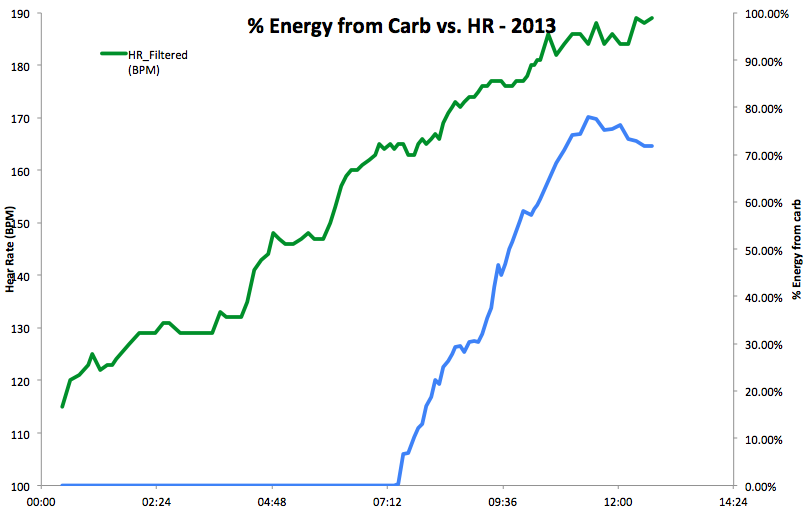


OK, so the graphs aren't useful for working that out, but the numbers are and the headlines are:-

How long I have on stored glycogen (conservatively)
How much carb/hour I need to refuel, after running out of glycogen

So... in practical terms, what I'm normally doing now is eating my usual low carb/high fat diet right up until the morning of a race.  On that morning, I'll have a breakfast (3-4 hours before the race, so if an afternoon one, then adjust the time to match) of scrambled eggs, with avocado and cream cheese, or cured meats with boiled eggs and cheese, with a mug of tea - very my normal breakfast! During the race, I'll have water with electrolytes and that's pretty much it.  On a very much longer session/race I'll take something if I think I might just get hungry (cheese/nuts/cured sausage) and a fuel bar or two for emergencies (something like a Clif bar).  I raced a half ironman a couple of weeks ago and ate nothing apart from one speculative gel at the start of the run course, because I hadn't gone through the new data properly yet - turns out I didn't need it (lots of analysis around pace and heart rate during the race confirms that well enough for me to be happy with that).  And I raced pretty hard, so I'll take that as an encouraging data point for me.

What I'd say, to others who want to take steps into this stuff, is that if you have a few months to try things, do that and see how things feel - don't be afraid to add in a bit more carb on the day of the race, your body will use it unless you're pretty much walking the whole thing or are very very highly trained and run very slowly for your ability.  If you don't have a lot of time, I'd say have a normal breakfast on the day of a (longer) race and if you feel you want the safety net during a (longer) race, try something more natural with minimal sugars, or even home-made fuel bars where you can control the ingredients to things you know are fine for you.

For me... this all means I can experiment a bit and play it pretty fast and loose with taking on carbs during higher effort training and racing.  I've heard a number of accounts that state that once you're actually exercising, you don't suffer the usual difficulties related to insulin responses to carbohydrate , though there are some that say you need to be careful as if you do stimulate high insulin response it will interfere with your fat burning capability during the exercise.

At the end of the test, looking at the initial numbers, the tester summarised with "Endurance. The longer the better. You will have a phenomenal advantage."  Along with "Those results border on the freakish, I've rarely seen anything more extreme."  *beam*

Wednesday, 31 July 2013

Race Report - Virgin Active London Triathlon 2013, Sunday (Olympic distance)

Having had a bit of fun on Saturday and a lovely meal with team and some of our sponsors in the evening, the alarm went off at 04:30 on Sunday morning.  I wasn't due to race until 12:25, but Mr TOTKat was off at 06:30 for the Olympic Plus (1.5km swim, 80km bike, 10km run) so we had to be up, breakfasted and in the Excel centre at 05:30 to rack up and get him ready.

For the second time in 9 months I had porridge for breakfast, with a healthy handful of California Raisins (oh how I have missed raisins!) and some actual sugar in it.  I figured that as I'd taken a good chunk out of my carb stores on Saturday by having a bit of a burn above the threshold where I start to burn carbs at an appreciable rate, I wanted to make sure I'd topped them back up again before my midday effort.

Somewhere around 160BPM there's a knee point in my ratio of fat:carb burned
I cheered off Mr TOTKat and the rest of the Freespeeds who were doing the Olympic Plus and went to get a coffee in the 20 mins I then had before they'd start to come in off the swim.

After cheering them all back in from the swim; Dion, Matt, Hobbo, Cat, Ali, Dec and Mr TOTKat I then needed to go and find some food to bridge the gap I was going to have between a 5am breakfast and finishing my race some time around 3pm.  Food scored, I headed out onto the bike course to wave at the guys with Jenny, Mette, Richard and the twins.  Then a quick look at a bit of the run course to take photos and it was time to get myself into a wetsuit and head for the swim assembly point.

Having put in a 15 minute easyish, fully-drafted 750m in the sprint on Saturday, I wasn't sure how the swim would go.  But I tell you what, I did the one thing I really wanted to do in every race for the last 10 or so and I started out really hard.  I led the whole wave for the first 200m!  Then faded a bit and fell into a rhythm, sadly in clear water with no toes to draft off.  I dug in and just decided to try to stay as on-course as possible and make sure I got some water into my wetsuit at the top just before the end so it would slip off easily given I struggled a bit on Saturday with my shoulders (they're big shoulders and they didn't get all that wet, so that does make it difficult.)


Best Olympic distance swim ever!  PBd by 21s and without putting a huge amount of effort in; 9th in age group too.  Quite pleased with that.  The run up to transition was a long one, thankfully it was compulsory to take off wetsuits before running up the stairs to transition.  My choice of racking point, although easy to find, meant that I had a long ol' run to get to my bike, but a shorter run on cleats from there to the bike exit.

Helmet on, followed by race number belt, bike shoes and sunglasses.  Bike unracked and then a trot off to the mount line.  A two lap route, with some roundabouts, undulation and the Limehouse Link.  Fun!


Garmin had a little trouble in the Limehouse Link tunnel, as you can see from the plot straight-lining below on the map...


And I was *shifting* on that course.  Yes, it was a bit windy and I got a good few hard gusts that pushed me across the road a couple of times.  But I had some fun and I got up the confidence to let go through the Limehouse Link and let the speed really pick up - the shame is that Garmin loses coverage through there so doesn't show the speeds I managed through the tunnel - reckon I probably gained an extra 15kph on top of the speed I was doing entering the tunnel (you can see the blue line on the graph stops each time I go through the tunnel - 6 times in all).


I got back to transition to find my bit of the racking void of other bikes, the odd one hanging but really only the odd one.  I felt great - in an "on the edge" kind of way at times due to the windy gusts and the speed through the tunnel down on the aero-bars and with no way to get to the brakes in an emergency - but I did ease off a little at times, so I know I could have gone harder.  I did remember to get into a low gear before that nasty little trick hill up into transition at the end of the bike, but slipped gears quite a bit and worried myself that I might fall over like a couple of ladies did in front of me on Saturday.  1 hour and 8 minutes, only a minute quicker than 2011 where I had had no idea about anything, had done the odd bit of cycling and was on a road bike.  That said, it was quite a bit windier this year and I did come in 4th in my age group this time.  I'll take that.

Check that lean :oD

The run was a 3 lap course this year, only 3 times up the slope into transition, but a lot wigglier, and hot and windy too.  I felt horrible throughout the run, but while I was doing it I completely forgot that if I feel terrible, it means I'm not slacking on effort too much.  So despite failing to be able to get my heart rate to go over 170bpm (proper effort running at that distance puts me 180bpm+), I managed to PB the run by a couple of minutes over my all time Olympic and several over last time on a course & conditions that have been recognised as a bit tougher than 2011.


Over the line in 8th place in my age group, up from 32nd in 2011.  I think I'm happy with that, given I've not been training for this distance specifically, but for 70.3 really.  It's a shame I have no finish line photo, but I do like this one from the run course.


All in all, it was a great weekend and I really really enjoyed it.  Above and beyond my own racing and having fun with the team around the expo etc., Mr TOTKat got out and raced for the first time since IM Wales last year (knee injury for months since a half marathon in October); he had a great race, hit his goals and I'm really happy for him too!

Monday, 18 February 2013

London Ultra (race report)

(I've done a brief report on the low carb/high fat thoughts for the race here - this is the fluffy race report)

6am on Sunday 17th February 2013 and I'm waking up to a day with the longest run of my life so far, having run further than 21km only twice before this day.  And today I'd be running 51km.

MrTOTKat (on race support duty) and I got up and breakfasted on scrambled eggs, smoked salmon, baby plum tomatoes, coffee and cream before packing water bottles, post-race clothes and shoes into the car and off to pick up @abradypus and head to the race start near Grove Park station in East London.  At 7am on a Sunday, traffic is pretty OK crossing town from South West to South East and we made good time, arriving at registration at 5minutes to 8am despite setting off a few minutes late.

Registration was quick and easy and the room was filled with people munching on chocolates being handed out, bananas and various chewy bars.  Pointy-looking, fit-looking people.  Not like me (or so I think).  It's pretty chilly, so I'm in a few layers: Under Armour base layer with long thumb-hole enabled sleeves and a 1/4 zip, Under Armour long-line compression knickers (both from Sport Pursuit), my old Nike Run To The Beat t-shirt (best running t-shirt ever!), Under Armour fleecy beanie (£8 from T K Maxx :o)), Bridgedale running socks, some lovely warm Thoosa running tights (again from Sport Pursuit), Nike running gloves and a buff from Blacks (own brand, I think, 2x for £10 on sale a while back).  My support kit - a Camelbak Delaney Plus run belt which has 1x closed pouch (holding iPhone and extra battery pack for safety and being able to upload position to GarminFit), 1x mesh pouch (holding "emergency salami" and a middle-warming haramaki in case I got cold), 1x bottle holder (plan was to swap in a bottle at each check point if I felt I needed it).


We stood and chatted for a bit, listened to the race briefing (you really need to look up "tyre girl") before strolling to the start, a wave of the flag by Rory Coleman and we were off.

The plan was to start out at around 07:40 at a nice high cadence to warm up and then turn it up from there to keep my heart rate on or below 170BPM.  OK, I didn't quite do that as that meant falling off the back of the entire field and that would have been too depressing at the start, so I picked up to keep up as the rest of the runners swarmed down the middle of the road and held up a bus for about 5 minutes before thinning enough to fill the pavements without too much problem.

I thought I'd get space to myself pretty early on, but it didn't really happen and  I fell into a bad habit of following people in front of me.  You don't do that.  You can't be sure the people in front are going the right way (and I hear later on from "3 guys in blue" that they did it, ended up 1.5 miles off course before realising, sorting themselves out at the others carried on going the wrong way).  But I did keep an eye on signs and got tuned in to the various combinations of Capital Ring signs on high posts, little logos on low posts, "Ur" stickers and yellow spray-painted arrows that marked almost the whole route (more on the "almost" later).

So, despite not really wanting to talk to people as I generally prefer to run alone, I find that talking uses effort I'd rather spend on the actual running and I either end up running too slowly or too quickly when with others, I ended up running and talking to people.

Bits of London came and went and I recognised parts of the route from having read the Capital Ring leaflets and plotted the course to load onto my Garmin 910 watch (which I had on).  Check-point 1 came up pretty quickly and I took a bottle from MrTOTKat, glugged down half of it, ditched my hat and gloves as they were too much now, and carried on without taking a bottle with me.  On entering Crystal Palace Park I spotted loos and decided it would be a good idea to make use of them and took my leave from Dave-the-teacher who I'd been chatting with to that point.  I spent a bit long in the loo, due to making sure that all of my layers went comfortably back in place without wrinkling, and ended up running alone for quite a while after that.

See the little scribble just inside the East side of the Park? Loos :o)

I don't remember much of the next bit of the route.  There were quite a few sharp little hills and I walked up those to manage my effort level/fuel burn, paranoid that I'd run out of carb and have to slow right down (probably to a walk) before I got to the end of the race, and there were a few odd little bits like where the route wriggled around the back of a kiddies play-park.


Then I overshot a turning by a few metres due to a bus being in a bus stop and obscuring a sign I caught sight of briefly then misplaced where it was...


Very quickly recovered from that and carried on alone for a while longer and up came check-point 2 and MrTOTKat was ready and waiting with a smile on his face, a full bottle in one hand and a half full one in the other.  I think I made a mistake at this point as I put the 1/2 full one in my bottle holder, swigged a bit of the full one and carried on.  I wasn't all that thirsty, so I thought it was OK.  Quite quickly I regretted the bottle I was carrying as it changed the weight distribution that I'd got used to and it tempted me to swig frequently like I used to on long training runs last year.  Not good.


Onwards, still alone, past Tooting Bec Lido and up another mean hill before my Garmin shrieked at me half way down a road I'd been following Capital Ring signs into, with no turnings that I'd spotted, telling me I was now off course.  And it kept at it, so I stopped, turned around and headed back to see if I'd missed a turning, to see "3 guys in blue" (3 of the other runners, dressed in the same blue shorts and tops and apparently running for a testicular cancer charity - Dave, Ian and Nick) thundering towards me.  I asked if I'd gone wrong and they were sure I hadn't, so I carried on with them for a little bit, chatting away before I realised their pace was too high for me and I let them go on ahead without me at Wandsworth Common.


Memory fades again at this point a little until I saw signs for Earlsfield and recognised bits of local territory and I motored on towards Wimbledon Park, through the building site mentioned in the race briefing which meant I was at about the half-way point and on into the park, around the kiddies play-park, alongside the lake and then down the side of the athletics track where I'd set my 5km PB only 4 days earlier.  Check-point 3 hove into view and I chatted to MrTOTKat a bit about my stiffening right quad, sore feet and achey glutes which had come on noticeably since check-point 2, and dropped off my buff as that was making me too warm too now.

Digging the empty bottle out of the holder - attractive pose!

I ditched the empty bottle, drank half of another bottle and went on without a bottle for the next section of the route.  And this next bit of the route was going to be nicely familiar, but I knew it would be muddy and a detour from my usual routes across/around Wimbledon Common.

Brooks Pure Cadence
Asics - Fuji Attack
I did go off course just past the windmill as I missed a low-level Capital Ring sign, but realised really quickly, swore a bit until I saw it and set off down a steepish, muddy descent.  The mud had begun in earnest and this was the section that made me worried about footwear for the previous two days.  Trail shoes?  Road shoes?  I'd plumped for road shoes in the end because most of the course is on pavement, tarmac, gravel or paved paths and my cushioned trail shoes (Asics Fuji Attack) are appreciably heavier than my cushioned road shoes (Brooks Pure Cadence).

The next part of the route across Wimbledon Common and then across the A3 (where I bumped into @abradypus who very kindly stopped me from heading off on totally the wrong heading at the junction) into Richmond Park was very muddy.  Very very muddy bridlepath at the beginning, then once in Richmond Park just a boggy field in which I lost my right shoe right at the first edge of the field, accompanied by a sucking-popping sound from the mud and a loud squeak from me.  From here on in, my already abraded feet were scraped further by the gritty mud that got squeezed into my shoes and socks in this section.  My feet were soaked through and I squelched on through Richmond Park.


I got complacent following a few other runners up the little hill and we all missed a left turn just past Jubilee Plantation.  After a while my Garmin yelled again "off course!" but I couldn't see a path so assumed I'd just plotted the route from the leaflets in a way that disagreed with the signs (which had happened a few times before so far).  But when it got to over 500m off course and we were coming up on one of the park gates I was certain we were all wrong and off course by 1/2km.  We agreed on a route to join the course that seemed sensible (and didn't end up short-cutting) and we all trotted onwards towards the river and the Richmond check-point.

Once alongside the river, it got really really busy; loads of people out for a Sunday afternoon stroll with baby buggies, pushchairs, toddlers in tow, low-slung bicycles, sit-up-and-beg bicycles, scooters, couples strolling hand-in-hand... a normal busy Sunday by the river.  I let the other runners I'd got a bit off course with go on ahead as they were quicker and then we crossed the river again and I was alone.  But I started to overtake people.

Check-point 4, the last checkpoint, 24.5 miles into the 31 miles  and I was sore and it looks like it was showing (though I was slowing to walk when this photo was taken so I could pick up water).  And here I made a big mistake and didn't realise it for a little bit.  I just picked up a half-full bottle of water and ran on with it.


The next stretch was really quiet, long and impossible to get lost on even when it diverged from the river and then dove into Syon Park.

See the line of trees to the right of the red line? That's where the path is...
I had "fun" in Syon Park as I followed the "Ur" stickers along the tarmac road, running on the right as you do when there is no pavement.  There was a little path a good 30-80m from the road at varying distances along its length, but I figured that the stickers were along the road and there was no need to run further than I needed to, so to speak.  The traffic handled it perfectly fine, as it should, until a very angry woman driving in the opposite direction gesticulated at the path and yelled at me to get on the damned path.  I ignored her as long as I could and then cracked and flipped her some Vs.

Under the A4 and down the canal a bit, waving and "good afternoon"ing the boaters along the tow-path, over the river again and overtaking a good few more people who were now walking even on the flat, my legs were really starting to get pretty sore but my feet were drying out, but the worst part was that I got thirsty.  I drank the rest of my water and still had a little way to go.

I realised I'd need to beg for some water from someone else and started to check every bicycle that went by for bottles; there were no other runners in sight.  And then I found someone... who had water and plenty of it left and kindly let me have a drink, then filled half my bottle with it.  I could taste something faint and sweet in the water and asked what was in it.  I feared the answer (it could easily have been a carb mix), so the relief was immense when the answer came "Nuun tablets".  Phew!  No sugar!  I thanked the guy and trotted on as he was walking, but then he started running again and we ended up running together around the massively frustrating paths/bog/quagmire of Brent Lodge Park and then Brent Valley Park and stayed together, chatting along as I counted down the distance still to go.

Frustrating, looping part of the route.
Steve, as was his name, was in quite some discomfort and was grunting with the effort of each step and I joined in occasionally on up or down slopes and steps as my right quad was by now really quite painful.  The OK kind of pain though, the pain of use rather than injury.

Things were really sore now for me too and every time there was a little hump-backed bridge to go over a stream, or steps up or down or a little slope became very difficult.  It was hard to control the descent more than the rise, but the rises were difficult too.  We were so close to the finish and for the first time I had mild thoughts of wanting to walk.  But I wanted to finish in under 6 hours and do as well as I could with the fuel and fitness I had.  Steve and I encouraged each other on in our own ways, his more vocal than mine and I felt so much better after the water he gave me that I ignored the "go on, just walk" thoughts and carried on trotting.

Then we crossed that final road and saw the sign for Perivale Park where the athletics track and the finish line were!  We were so close!  We turned right into some trees and my Garmin announced we'd got to the finish a little prematurely, but we picked up another runner and headed for the track.  Steve ducked in through some more trees to the track and he and the other guy sprinted down the track to the finish, leaving me for dust behind them with nothing left in my legs but I still carried on running and ran over the line.

Me, finishing!
Got a medal and a goodie bag presented to me by Rory Coleman and I triumphantly produced the square of snickers I'd picked up at check-point 4 where I told MrTOTKat I thought I was in serious danger of running out of fuel as I was burning my heart rate too high too often.  It was untouched from check-point 4 and I'd not had to eat it, nor any of the nuts or salami I'd carried with me in case I felt uncomfortably hungry.


I'd done it.  51km on a breakfast of salmon, eggs and tomatoes with coffee and water with electrolytes while on the route.  No gels, bars, sweets, snacks from the check-points, energy drinks, cola or sugar in any form; no food or calories; just water and salts.  I didn't run out of fuel, I ran out of endurance strength/form/support in my legs.  And I felt fine!  Perky!  The lady who massaged my legs said I didn't look tired at all.  51km in less than 6 hours, at an average moving pace of 06:45/km.  3 PBs in 4 days - fastest 5km ever by 91s, fastest 42.2km ever, and longest run ever by 9km.  The only disappointment was lack of hot drinks at the finish and it was quite a big disappointment as I was really looking forward to a cup of tea.

My shoes and feet were caked in gritty mud...


But hey... I had a medal and I'm now an Ultra runner, no matter what people think about the 50km distance.


And thanks to MrTOTKat for making me a yummy dinner (bacon, eggs, tomatoes, cheese and no-carb "bread") that wasn't giving in to the the convenience of a Dominos pizza.  And for the fantastic support through the day, ferrying to and from the race through the awful traffic on the way back and being there at the check points with everything I needed at the right times and words of encouragement and pride.  <3

The results are out and my official time was 5 hours 51 minutes (Garmin which auto-pauses says I was on the move for 5 hours and 41 minutes).  I was 18th lady across the line of 38 that started, 178th across the line of 246 people that started, two didn't finish.

London Ultra (LCHF edition)

(The human, fluffy race report is here, the low-carb report is below.)

So, I've run two half marathons and two more as part of Ironman 70.3 races, and one marathon as part of an Ironman since I started running in July 2009.  I've also got my longest training run of 28km once, but since July 22nd 2012 (Ironman UK 2012) I've not run further than 15.5km in any training runs and only one half marathon race.  Of course it was a great idea to sign up for a 51km Ultra Marathon!

July 2009 - started couch-2-5K
October 2009 - first 10K run/race
September 2011 - first 1/2 marathon
July 2012 - Ironman UK (first/only marathon)
February 2013 - London Ultra

Seems a logical progression, right?

Add in the fact that I changed to a low carbohydrate (high fat) diet at the start of November 2012, and, against conventional sports wisdom, planned to race without loading up on, or taking on carbohydrate during any race as far as is practical and you get a quite interesting place for a 51km long running race course.

I train with water and electrolytes and otherwise just end up eating a little more on training days than rest days, averaging around 2400kcals per day.  And there are a few reasons I want to race without taking on carbohydrates (faff, stomach trouble, personal lack of skill, time-wasting, not being comfortable with the contents of gels/sports drinks/sports bars in general, insulin spikes).  This 50km Ultra race was going to be a fantastic, practical test of the theory of fat-fuelling exercise for me.

In the run up to the London Ultra on Sunday, I decided to work out how long I could run for and at what effort level before I depleted my body's glycogen stores.  I had the gas analysis figures from the beginning of December last year and Excel in my armoury...

Complicated with a lot of assumptions:-
  1. liver glycogen as normal
  2. reduced muscle glycogen stores due to day-to-day diet
  3. using muscle glycogen from mostly lower half of body
  4. lower half muscle mass is 2/3rds of overall muscle mass
  5. weight approx 62kg
  6. body fat of approx 25%
  7. no added carbohydrate from breakfast (4g carb, coming from 100g tomatoes and 40ml double cream)
  8. improved heart rate threshold for changes in fuel burn by approx 5 BPM since gas test


Using those assumptions, the calculations dropped out the rough reckoning of needing to maintain a heart rate of 170BPM to be able to last for 6 hours on the carbohydrate stores from my body (estimated to be 1500kcals from the initial assumptions above and a burn rate of 4.2kcal/min of carbohydrate).  You can see from the graphs and below spreadsheet fragment that the time (Time on CHO column below) drops off a cliff at 166BPM when it was tested (and I'm assuming an improvement of 5BPM in threshold since this test).


Stats from my HR monitor for the race:-
HRavg   - 171
HRmax  - 179

Pretty pleased with my effort management (it's missing the first 15mins due to trouble before the start)
So I kept fairly close to the heart-rate I'd intended.  But, for every beat per minute above 170 I burn around an extra 10kcals in carbs per minute so it starts getting very carb costly very quickly when I go above that number.

To cut the long story short, I had scrambled eggs and smoked salmon with a few cherry tomatoes for breakfast at around 06:30, the race started at 08:59, I finished at 14:50 having had only water with High5 Zero tablets in (and about 300ml water with Nuun tablets in).  I did not bonk.  I maintained a steady 06:45/km throughout (apart from a wee stop and short stops at aid stations and traffic lights).  I maintained an average heart rate of 170BPM.  I did not feel tired.  I was perky at the finish.  The bits of me that hurt was my calves, quads and soles of my feet and I needed to stop when I did because my fitness and muscular endurance levels had limited me (remember, I have -not- trained for anything like this distance in the slightest), not my fuel.

Endurance racing without carb loading or taking on carbs in a race is possible.  It isn't painful or difficult.  Fat adaptation works.

And I want to try this again but with race-specific training and better long distance fitness (i.e. able to run quicker for the same heart rate/effort level).  Time to ponder when that might be practical; possibly after 70.3 Zell Am See, seeing as I'll likely ditch 70.3 Lanzarote now.

Slightly less boring race report with nice photos coming next!

Monday, 11 February 2013

London Ultra: Impending Fear

Next Sunday I'll be running the London Ultra; a 50km course around London, mostly clockwise on the Capital Ring from Mottingham/Grove Park to Perivale, through quite a few London parks, heathlands and otherwise green bits.

You'd think that for my first run longer than 42km, in fact only my 2nd ever run over 28km, I'd be fearful of the distance and the fact that I've not run further than 15km in one continuous run since June last year.  But no, that holds pretty much no fear for me.  I know I can cover the distance, yes my hips will likely ache somewhat at some point around 35km in, and the balls of my feet too if I pick the wrong shoes, but there is another fear...

Brooks Pure Cadence (probably my choice for this)

Getting lost.

You see, despite the web site saying cheerful things like "London's Capital Ring provides a wonderful waymarked route which is easy to follow and can be run at marathon pace", the course (now in it's 2nd year after a course change following the first two runs), is well known for people getting lost, and lost more than once along the course.


I've done my research, I've looked at the course route and I've read a god few race reports from last year and they all, without fail, mention getting lost at least once.  Now, if there's one thing that's guaranteed to drive me crazy in a race, it's poor route marking.


I really don't want to get massively angry as it's so energy sapping and this will be my first endurance event of any notable duration where I will not be fuelled on dietary carbohydrates (I'll carry some bits of sausage, some nuts and cheese in case I feel hungry but it takes so long for that food to get processed it wouldn't be any use to fuel the running I'll be doing at the time, I'll be relying on body fat and liver glycogen).  I'll need all the mental energy I can get and wasting it on fury will be very counter-productive.  Yes, I'll have a map, but I really don't want to be getting it out to look at it every 5-10 minutes.  The route is pretty twisty and there aren't any long stretches where you could zone out and enjoy the motion.  I've not been able to convert the KML file from Google maps into a file that my Garmin can read, nor am I convinced about the manually transcribed route I've made in Garmin Connect as it's based on the official Google maps route that doesn't follow paths or roads and you can't tell which side of the river it's on at times, plus it looks like it goes through buildings a lot of the time - it looks like a low resolution GPS file.

So if anyone knows the Capital Ring (Sections 3 to 8) at all, or has walked/run bits of the route, or has run the London Ultra route (2012 onwards), or just generally has any suggestions on how to stay on track, please do let me know!

Monday, 28 January 2013

Weight Loss: There is A Better Way

If you've been following my "weight loss" series, I've now got to the point where I'm going to be even more blunt and opinionated.
  
When it comes to the matter of body weight/fat there are two types of people; people who have a metabolic/endocrine problem and people who don't.  I previously thought the former group was vanishingly small, but I've been reading and learning a lot and I've changed my mind.  People with genetic, pre-existing endocrine problems -are- rare; people with acquired metabolic problems are pretty common and it's usually varying degrees of insulin sensitivity from the sensitive to bordering on type II diabetes and mainly due to battering the body with high levels of (refined) carbohydrates until it starts to give up.


Gary Taubes, Tim Noakes, Steven Phinney, Jeff Volek, Peter Attia, Yoni Freedhoff and many others have researched, thought, read, and digested (pun intended) on the topic and have come to the conclusion that the modern obesity pandemic is caused by cheap, freely available, highly processed, large amounts of carbohydrates in the human diet.  Not just Western society; but increasingly across the whole of the world and as the availability of cheap, highly processed carbs increases, any given country will see an increase in obesity, diabetes and a number of other chronic diseases.

If you put on weight quite easily, are slowly gaining weight as you get older, have a high waist-to-hip ratio, struggle to lose weight or maintain healthy weight, crave foods, get hungry a lot of the time, think about food a lot (in terms of when/where is your next meal coming, or how you can justify eating X or Y, not in terms of a recipe you'd like to try 'cause it looks interesting or it's your job etc.) you are probably along the path to insulin insensitivity/resistance.  If that is the case, you would probably benefit from a low carbohydrate diet for general health reasons and a side-effect of a low carbohydrate diet could well be weight loss.  When I say "diet" here, I do not mean it in the sense of "going on a...", I mean it in the sense of what you eat for now and forever.

If you don't put on weight easily, have a relatively healthy waist-to-hip ratio, don't vary much in body weight with time, have no problem losing a few pounds (maybe for the racing season?), don't get food cravings, don't have "intrusive thoughts of food", then you're probably towards the "no problem" end of the insulin sensitivity scale.  You're quite lucky.  Also, a low carbohydrate diet will probably have little effect on your weight.  That said, there are a good few reasons why you might want to move to a higher fat (and, logically, lower carb) diet (have a read of Why We Get Fat and what to do about it and/or The Great Cholesterol Con).  I don't mean to the extent of this...


...but golly-gosh there are a lot of good things in some of them thar fats like olive oil, avocado oil, coconut oil, (grass fed) beef fat, (wild) salmon, mackerel, herring, (grass fed) butter and milk, (free range, organic) eggs, macadamia nuts, brazil nuts etc.

So if you are away from the lucky end of the insulin sensitivity scale and want to change, take a look at your diet.  See how much white flour, potatoes, sugar, white rice etc. you eat, or even how much brown rice, brown flour, brown pasta, bananas, fruit juices etc. if it's more than 200g or so per day.  If you are struggling to lose weight, suffer unpleasant hunger/cravings, can't make it work on a calorie counting diet (usually low fat), CHANGE THE STRATEGY.  Swap low fat for low carb.  Eat real butter, milk, cheese, eggs, meat, fish and feel less hunger.  If you go low enough carb for a few days you'll stop getting cravings, stop the constant thinking about food, stop the horrible hunger sensations.  You'll enjoy what you're eating!  You'll start to find that things like strawberries are insanely sweet-tasting without adding sugar because you can actually taste them properly.  You'll start to find that you don't need a huge plate piled high with pasta, rice, potatoes, bread etc. to feel satisfied after a meal.

And if you think it's all too much like hard work, there are so many quick and easy things you can make/cook/grab on the go.  And if you think low carb is too restrictive and all you'll be eating is bacon and eggs... well, there's a lot of help and ideas and once you get going it's really really easy.

Thursday, 20 December 2012

Giving in to temptation

No, I've not been eating refined carbs.  Or even appreciable amounts of carbs, or processed food.  What I -have- been doing is over-indulging on wine.

You see, wine seemed to be something I'm relatively tolerant to on the scale of Things That Contain Carbs.  It's not all that carby anyway either.  And with one thing and another and the time of year (yes even I have noticed it's almost Christmas) and the fact that I'm a bit mopey about not feeling confident about getting out on my bike on the roads, I've wanted a bit of a pressure release valve that's not going to totally undermine my low carb work so far.

Last week was very bad in the "just how much have I had to drink?" stakes.  I'm too embarrassed to confess to the number of units, but let's just say it's a bit more than the recommended maximum for women.  This week has been better, but my liver/kidneys etc. haven't really recovered from last week.  So, I'm retaining water like nobody's business (hello extra 1.5kg in water weight in 24 hours!), I'm slower in the mornings than I have been for weeks, I'm getting to bed later, getting up later, getting lower quality sleep (still sleeping right through the night though, which is a novelty still despite having 6 weeks of it so far) and eating food when I don't really need it - which is vanishingly rare on my new nutrition regime; it simply doesn't happen when I've not had a drink.  I just may well be not as tolerant to wine as I'd thought.
So, in an attempt to work out whether it's causing one problem or another, I decided to see about looking at the effects of wine on my insulin responses in the cheapest way possible.  Using a blood glucose monitor (£15 from Boots), assuming that all things being equal, and assuming that if I hadn't had an appreciable intake of carbohydrate from food and my blood glucose level drops measurably after drinking wine then it means I've had an appreciable increase in insulin swimming about because of the wine.  It's going to need a lot of trial and error and data points to get a picture of what's happening.

So far I have some morning, fasted glucose levels and a few data points from after fasted exercise, a lowish carb meal, 1 glass of wine and 2 glasses of wine.  I've also just found better information on the insulin response and glucose levels due to food intake (for non-diabetic and non-pre-diabetic people) and it looks like the peak in blood glucose happens 30 minutes after a meal starts and things should be dropping down appreciably 60-90 minutes after you're done eating and back to fasted levels 2 hours after the meal(1).  Definitely more data required for a proper analysis of any kind, but so far it seems that:-
  •  my blood glucose does drop after 1 glass of wine and stays there after the 2nd
  •  my morning fasted glucose level is variable by ±0.5 mmol/L around 4.4 mmol/L
  •  I need to test glucose before, 30 minutes after meal start and then 120 minutes afterwards
It'd be good to do this for different meal contents to see if there are differences, do the same for wine in isolation, then when I have a baseline look at adding in experimental things in isolation to see what foods I may be able to easily tolerate in terms of keeping away from spiking insulin levels.  Also of interest is insulin response to things that have fake sugar in, e.g. Diet Coke.

[1 - Blood Sugar 101]

Thursday, 13 December 2012

It really is that simple

It's been 5 weeks since I wrote this post about being more coated in fat that I was happy with and despite the fact that it showed I was a bit miserable about my body image at the time, I'm glad I wrote it.  It prompted a helpful, knowledgeable, medically trained pro triathlete to point me at a book by Gary Taubes - "Why We Get Fat and what to do about it".

I devoured the book, my brain being challenged in the first couple of chapters as Taubes grinds against all that we've been taught all of our lives about food and nutrition.  He writes convincingly, refers to reams of studies and papers and honestly admits there are holes in the understanding so  I decided immediately that I wanted to try out the theory of what he was describing and then read a load more books and articles.

The basic premise is that (in most people except those with type 1 diabetes and a few other metabolic nasties) carbohydrates, and increasingly the more refined and further from foods that pretty much cave men would have had access to, provoke insulin responses that result in the laying down of fat in the body.  It's worse for some than others, some people seem to be carbohydrate tolerant all their lives and some deteriorate over time and exposure to high levels of carbohydrate. For many who are not carbohydrate tolerant, the fix is to significantly reduce carbohydrate intake, and pretty much eliminate the most refined types; sugar, white flour and other processed grains.  The trap that many fall into when reducing carbohydrate intake is that they try to eat low fat foods too and Taubes (and Phinney and Volek, and Noakes and others) explain that fat isn't as evil as we've been led to believe, and eating fat neither makes you fat, nor increases the "bad" cholesterol (small particle size LDL) and in fact eating high proportions of fat can increase the "good" cholesterol (HDL) and possibly change the type of LDL cholesterol from smaller to larger (medium and large LDL particles seem to be associated with no elevated risk of heart disease) circulating in the blood.  It can also assist in correcting excess body fat.  Additionally, the reason humans need lots of fruit and vegetables to get hold of vitamins and minerals is because the high carbohydrate in the diet creates the extra requirement for higher amounts of them all in the diet to be able to metabolise and use them.  If you reduce the carbohydrate dramatically, you can get almost all of the nutrients you need from animal products (meat and fat) apart from vitamin C which is special. (It is possible, if difficult, to achieve the same effect with a vegetarian diet.)

So, for 5 weeks now, I've been eating a low carbohydrate, high fat diet.  And the biggest, easiest change to notice is that I don't get hungry.  Someone asked the other day "what do you eat for bulk in your meals, so you feel full?".  If you're eating low carbohydrate, hunger and "fullness" don't work or feel the same as they do on a "normal", Western, high carbohydrate diet.  When I eat a meal now, I feel full mentally and on the inside when I've had enough to eat.  I don't feel physically full, or that my stomach is reaching/has reached capacity in the way I used to feel at the end of a meal.  It feels odd and different initially and was quite disturbing for me the first time as it was a pretty hard and strong signal "STOP EATING. NOW! OR ELSE!".  Conversely, I don't get mad, desperate need or desire to eat.  I don't get cravings and when I'm preparing food I don't feel the need to graze because I can't wait until the meal itself.  I don't miss any foods I'm no longer eating, though I can appreciate that they were once delicious and desirable.  They're just not desirable any more.


On an average daily intake of over 2,000kcals, the kcals value of which has not changed from before I changed to a low carbohydrate diet, I've now lost 4kg in 5 weeks.  And I've been drinking more wine than for the months before that (probably a bit too much, if I'm honest).

Intake from 8th November to 12th December

It really is that simple.  Keeping my amount of carbohydrate taken in below 50g a day (I've averaged 34.8g a day over 5 weeks) and eating as I feel otherwise (I'm logging food intake for interest and to keep an eye on the carb count), as Taubes, Volek and Phinney said, my weight is being "corrected" and it should reach an equilibrium point at some point and then stay there.  I have no idea what that weight might be and seeing as I'm the lightest I've been in my adult life, in fact since I hit puberty.

If you have struggled with your weight, find yourself getting a little heavier as you get older, are pre-diabetic, suffer from excess fat around your middle, have symptoms of metabolic syndrome, or are simply interested in the subject, I can recommend these books:-

I'm looking forward to exploring more and different recipes and meals in a couple of books that have caught my eye, but so far it's been delicious and exciting and I feel great.