Showing posts with label endurance. Show all posts

Saturday, 2 September 2017

LEJoG 2017: What's next?


While I'm still decompressing from LEJoG, I'm starting to think about what's next. I still need to write up the run but that's going to take time.

In the mean time... I've got a trail marathon coming up and I've entered the Rome marathon in April next year with the target of getting a "good for age" qualifying time for London (though I don't intend to use it). There's a plan forming for what comes after. Currently I want to build up to The Spine race. And I wanted to do Ring o' Fire then Cape Wrath as preparation, and that works for Ring o' Fire but 2018 is a Dragon's Back year not a Cape Wrath year. And I'm pretty sure that I'd be fine for Cape Wrath but Dragon's Back would be too much of a leap by then.

It seems like there's more thought needs to go into this to really figure it out. 

Plus it doesn't have to be races. LEJoG, Thames Path and North Downs Way taught me that. But if not a race, there's even more choice! I'm a starving person faced with an almost infinite menu!

What do you think?

Wednesday, 8 March 2017

LEJoG 2017 - 10 weeks to go!

Mmmtea!
I've got just over 10 weeks to go before I start running from Land's End to John O'Groats. That came around quickly!  Training, in as much as you can train for this sort of thing, went through a bad patch for a couple of weeks but is turning a corner again now.

I had a stretch of maybe two and a half weeks where every single run was awful.  I couldn't hit the pace on any efforts, everything felt really hard, I was too tired and stressed to fit in all my planned runs and I was getting really wound up about it all.  But then, as with all endurance events, things started to get better again.  Running to/from work is helped by great views like these, now that the days are getting lighter:

Hello goosey!

Turns out it's quite good running on that bank in the morning before the tourists descend

And my local trail haunts are gorgeous:

North Downs Way - my absolute favourite so far.

This run stopped me from going totally bonkers recently!

A few administrative points are coming together too; I have found a charity I would like to support and I'll talk more about that in a few weeks time once they've sorted out Gift Aid applications and I can link to a donations page for folks to help the cause. Looking to get one or two companies to support a little too, waiting to hear back from folks who know how to do that sort of thing because I have no idea how to go about it (too damned English and self-effacing!).

I've tested out putting up my tent and my tea/hot food making capability:

Needs a bit more practice with the roof tension.

Super roomy, length-wise and I'm not short.

This little fella is my best friend! And my trusty Asics :)
And after a false start with a different 30L one, I've found a pack to run with that fits properly, doesn't bounce around when I run and has perfect capacity for what I want to take with me.  It makes me feel a bit self-conscious when I run with it at the moment as it's designed for and marketed towards the Marathon des Sables market, but it's perfect and thanks to MyRaceKit for shipping swiftly so I could get on with using it and getting used to it!

Raidlight 30L Ultraraid Vest (shown here with iSIS Freeloader solar cell)

I've also put my spreadsheet skills to good use with a tool to figure out pack weight depending on what I'm carrying.  I just select the number of each item, it calculates the total weight and it's reusable for any event or training run :)


Saturday, 9 July 2016

NDW100: One month to go...

It's one month until my first attempt at the 100 mile distance.  Having absolutely loved North Downs Way 50, and the South Downs much less so, the choice was to go for North Downs Way 100.

The North Downs Way is simply gorgeous.  And it's a bit hilly.  So for annual holiday this year, we decided to spend a couple of weeks in the Lake District, which would give me lots of mountain trails to get into my legs as a bit of conditioning.

Mmm, contour lines.
Elevation... ooo...elevation...
It was the most glorious fortnight.  Sunny and mild for the first week.


Glorious views, climbs over rocks...


And fun little descents in the sunshine.


Did I mention the steps yet?


Then in the second week it got a bit more serious, I ran more by myself and the rain came in.


Sometimes we got wet, sometimes we didn't.


Sometimes it was pretty much scrambling, never mind hiking.


And more steps.  Good practice for North Downs Way!


So, all in all some pretty good endurance gains, hiking and steps practice and testing out wet weather gear pretty seriously (I got drenched for hours and had a tantrum when I got back to the cottage from one particular solo run - turned around and went straight back out to the shops and bought new stuff!)

Now it's 4 weeks out from the race and the nerves are already closing in.  Am I fit enough?  Am I too heavy for my strength capabilities?  Will I get blisters from shoes I want to run in?  I've never run further than 52 miles in one day, what will happen to me after 60, 70, 80 miles?  How will I cope with sleep deprivation?  Some of the answers are obvious and nothing to be worried about, but some need more thinking about and discussion with CoachJames.

I've already sorted out the pack/kit I will be carrying on the day (after freaking out on a test run home with 2.5kg pack) and I'm happy with the weight.


Full pack & kit inside the dry sack I'll be using to keep it dry (even if it doesn't rain, I'll sweat through my pack and get things wet).  Add 1kg water to take it up to 1.9kg at a maximum, add ~150g for a base layer and I'm happy.

Especially when I get to not carry this for the first 50 miles, so I can deduct 200g from the pack for the first half.


Some of the worries are diminishing, but some are still there and new ones will come up I'm sure - human brains are great at sabotaging themselves.

I've still got work to do before 6am on race day - a 16 mile run with full kit on a hilly route tomorrow (so, hey, why not the North Downs Way!?), 38 miles next week, 46 miles the week after that, 142 miles the week after that (because I'm an idiot, but it'll be at *super* easy effort), and 6 miles in the week leading up to the Saturday of the race.  I'll have run the first 25 miles of the route 3x before race day, the next 10 miles 4x, the first 50 miles of it twice and the rest once.  I'm not so great at remembering routes, so recce runs can be quite lost on me, but I'm sure it can do nothing but help in this case.  Having run one of the hills twice already, it was way less horrible the second time and I knew it was coming.

So, yes, I need to keep focused and keep trucking with the sessions and the mileage and not get stressy, bored, distracted or lazy just yet.  And see how I feel in the huge mileage week.  It could wreck everything, but I'm taking measures as best I can to see that it doesn't.

Sunday, 16 February 2014

Slowly slowly...

I've done a whole 3 training sessions this week; a cadence bike session, a short tempo run and a longer, harder turbo session (plus a 3 hour running technique workshop, but there wasn't a lot of running in total in that, lots of theory and drills but not a lot of actual running).  This is part of getting myself slowly back to fixed body and gently ramping up the intensity again.  The endurance hasn't really dropped off, but it's the strength, particularly on the bike, that I can't rush at the moment.

There's 2 weeks to Spring Camp and that's going to be quite tough this time; remembering back to last year there's a lot of cycling and there are Hills.  It's going to have to be gentler than last time, though I'm  quite looking forward to the discipline of swimming every morning before breakfast before heading out for a ride.  And now I understand more about fuelling for heavy exercise every day on a LCHF diet so the last few days should be a bit more productive than last year.

After today's 90 minute sit-down on the turbo, I'm feeling like it's not a total loss for this year and maybe I might actually be in with a chance of being in a good place come 70.3 Mallorca as a kick-off race and then UK 70.3 won't be the horrific, miserable mess it was last year.  Hoorah for endorphins!

Friday, 13 September 2013

Fat Burner - Part II (I'm a freak)

In November last year, I had a test done.  It was a test to see where I was in terms of how I use fuel during exercise.  The thinking was that I'd like to try to optimise to burn as much fat as possible and as little carbohydrate in order to make race fuelling easier, both in practical terms and in terms of being easy on my poor stomach after the experience I had in Bolton in 2012.

I turned out to be a reasonably good fat burner and I used the numbers to test the theory at the London Ultra in February this year.  Wind forward a good few months and I wanted to see what, if anything, had changed on a diet that had evolved a little to between 50 and 100g carb a day rather than the draconian <50g a day I started with last year.  I was slightly apprehensive that the slipping into very weird habits (eating cake a couple of times a week when I've never been that much of a fan!) and going a bit off the leash on a semi-regular basis since starting a new job in March might have ruined things a bit.


So... this stuff is both simple and complicated at the same time.  You may already know a lot of what I've written below, but here it is just in case.  (Also lots of it is very personal to individual circumstances, genetics etc. and lots of it/almost all of it has not a lot of hard research behind it, but we do the best we can.)

The simple bit is that the "best" way to improve your fat burning capability is in a gentle and controlled way. Just go out and run/cycle.  Even with all the technical information in the world at your disposal, there is nowhere near even 1% of the information we'd need to get this sort of thing absolutely right without some empirical, individual experimentation.  i.e. go out and do longer and longer runs at the target pace, carry emergency nutrition with you, but aim to complete the run without consuming it.  If you hit the wall, obviously eat/drink.  Take note of the results.

The complicated bit...

In general:-

  • When exercising, your body will use a mixture of fat and carbohydrate to fuel the effort.  The ratio varies with effort level.
  • Untrained endurance athletes will rely quite a lot on carbohydrates for fuel and the mass-market advice to consume 20g carb every 30 mins (or whatever it is) is a good safety net to avoid bonking/hitting the wall.
  • Untrained, not highly-dedicated fat burners will have a secondary problem to the physical wall in the mental wall too which is also physiological in root as it relates to what fuel your brain is using.
  • The human body contains approximately 2000kcals (varies mainly by body weight) of accessible glycogen (metabolic by-product of carbohydrate which the body uses for fuel, and more slowly generated from protein if there's insufficient carb available).
  • There is a hardwired limit for people that does not allow glycogen depletion beyond a certain level - i.e. some people can deplete to 20% remaining, rarely down to 5-6%, some are less lucky.
  • There are two or three points in the heart rate range where the ratio of fat to carb dramatically changes.
  • There is a point at which the effort level is so high that a body is using 100% carbohydrate to fuel the effort.
  • Taking in carbohydrate replenishes glycogen stores, but it takes a little while to process (20+ minutes depending roughly on GI)
  • Taking in protein replenishes glycogen stores but much much much more slowly than carbs.

Most of these factors may be altered through nutrition and training.  The "may" is more than likely genetic and there's not a lot of info about on the likelihood of whether a person may be able to alter the factors, but it appears that the majority of people who end up in elite/professional sport are able to and do do so to some extent or more.

The effort level for a given ratio of fat to carb can be altered/improved by any or a combination of these things over a period of months:-


  • Fasted exercise sessions - e.g. do a morning run before you have breakfast.
  • Add a little caffeine into your daily routine; can be very effective in combination with the above point.
  • Change your general nutrition plan to keep the amount of carbohydrates low or very low (the absolute threshold will vary from person to person.  For example, I seem to be able to "get away with" around 100g carbs a day, whereas some seem to need to keep below 20-30g a day.
  • Change your general nutrition plan to keep the amount of fat in your diet high or very high. Again the percentage will vary from person to person, but I hover around the 70-80% range.

From personal experience, I have found the first and last points to be the most effective in moving the thresholds in the right direction for me.

If you are particularly keen to switch your brain fuel from glycogen to ketones (i.e. from carbs to fat) you would have to be very very harsh with carb restriction; usually under 30g a day for around a week or so; during this time you're likely to feel fuzzy in the head, irritable and need more salt than usual.  The general effect of switching brain fuel is twofold: you reduce the impact on your emotional wellbeing when you do push hard and run out of glycogen, and secondarily it appears that you may be able to then access more of your body's glycogen stores and deplete them even more than usual when your brain runs on ketones.  Again, from personal experience I have bonked on a very low carb diet (after 6 days training camp, doing approx 8 hours training per day) and instead of wanting to sit in a corner and cry, I just couldn't get my legs to go at the speed I wanted them to, no pain or distress, they just refused to go quickly.  A much less stressful result.

If you have the time, spare cash (around £165) and/or inclination, you can get a test done, like I did, that gives you an idea of the ratios of fuel you personally burn and at what effort level the ratios change appreciably.  It's called a "gas analysis test" or "metabolic efficiency test" and the test is done on a bike or treadmill while strapped into a mask over your mouth and nose.  You start off at an easy pace for a warm up, then the recording starts of your heart rate, pace/wattage and the amount of air going in and the volumes of CO2 coming out.  The effort level gets increased every few minutes in steps to a reasonably hard level but not absolute maximum (this is not a "max test") and then the data collated and analysed.  You can then do some calculations on how long and at what effort you could safely run without needing to top up the stores and if you do need/want to top up you can work out how much and how often.  This is what I did for my 50km Ultra race in February and I calculated that at a heart rate of around 160BPM I could conservatively go for 6 hours before I might need to top up.  I ran the race at a HR of around 170BPM in 05:50 and kept pace the whole way around, no sign of legs ignoring me.  Oh, and I didn't eat anything at all, despite well-stocked aid stations full of goodies!

Now in the test last month, the numbers went in a good direction even further.


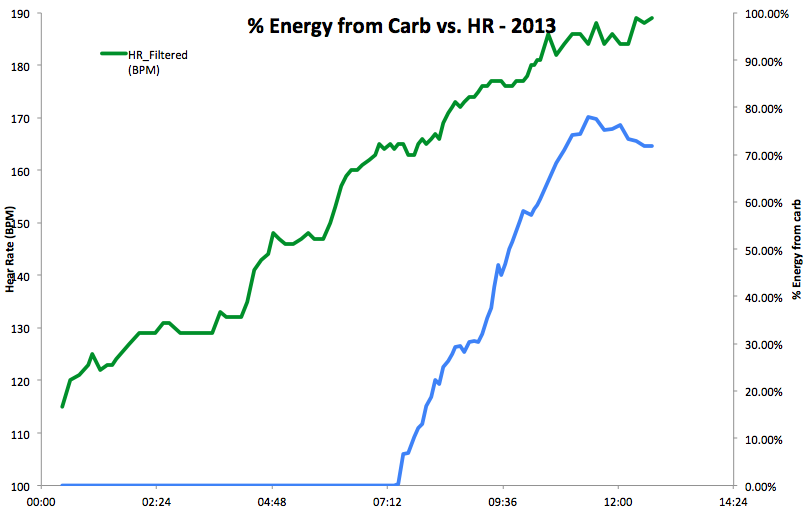
I'm burning 100% fat right up to a heart rate of 165BPM (on the bike) now.  That's 87% of my max heart rate (on the bike).  That's pretty phenomenal.  In theory, as long as I keep my heart rate under 165BPM, I could ride pretty much forever on my stores of body fat and not need to eat anything at all.  Apparently, this is fairly uncommon.  What's also uncommon is not switching fully to carb burning at high effort output - known as "going anaerobic".

The additionally interesting bit comes from the carb burn and how that varies, as that will tell me ballpark rates at which I get through my body's stores of glycogen and then at what rate I would need to replace them at in order to maintain that level of output.


OK, so the graphs aren't useful for working that out, but the numbers are and the headlines are:-

How long I have on stored glycogen (conservatively)
How much carb/hour I need to refuel, after running out of glycogen

So... in practical terms, what I'm normally doing now is eating my usual low carb/high fat diet right up until the morning of a race.  On that morning, I'll have a breakfast (3-4 hours before the race, so if an afternoon one, then adjust the time to match) of scrambled eggs, with avocado and cream cheese, or cured meats with boiled eggs and cheese, with a mug of tea - very my normal breakfast! During the race, I'll have water with electrolytes and that's pretty much it.  On a very much longer session/race I'll take something if I think I might just get hungry (cheese/nuts/cured sausage) and a fuel bar or two for emergencies (something like a Clif bar).  I raced a half ironman a couple of weeks ago and ate nothing apart from one speculative gel at the start of the run course, because I hadn't gone through the new data properly yet - turns out I didn't need it (lots of analysis around pace and heart rate during the race confirms that well enough for me to be happy with that).  And I raced pretty hard, so I'll take that as an encouraging data point for me.

What I'd say, to others who want to take steps into this stuff, is that if you have a few months to try things, do that and see how things feel - don't be afraid to add in a bit more carb on the day of the race, your body will use it unless you're pretty much walking the whole thing or are very very highly trained and run very slowly for your ability.  If you don't have a lot of time, I'd say have a normal breakfast on the day of a (longer) race and if you feel you want the safety net during a (longer) race, try something more natural with minimal sugars, or even home-made fuel bars where you can control the ingredients to things you know are fine for you.

For me... this all means I can experiment a bit and play it pretty fast and loose with taking on carbs during higher effort training and racing.  I've heard a number of accounts that state that once you're actually exercising, you don't suffer the usual difficulties related to insulin responses to carbohydrate , though there are some that say you need to be careful as if you do stimulate high insulin response it will interfere with your fat burning capability during the exercise.

At the end of the test, looking at the initial numbers, the tester summarised with "Endurance. The longer the better. You will have a phenomenal advantage."  Along with "Those results border on the freakish, I've rarely seen anything more extreme."  *beam*

Saturday, 16 March 2013

A tale of two swims...

Same session both times:-

  • 200m swim warm-up, 60s rest
  • 4x [200m swim + 30s rest, 3x 100m with fins + 30s rest, 4x 50m pull + 20s rest, 60s rest]
  • 50m swim down

Monday on camp:-


...where I did an accidental extra 100m with fins in the 3rd repeat of the main set.  And I don't know what the last couple of minutes in the trace was, but if you cut it out from the total time for the session is 01:09:10. (total distance 3.1km)

Today, by myself, with no-one watching and no-one with whom to sort-of compete a bit:-


Where I missed a 50m pull in the 1st repeat of the main set, but added it in to the 4th repeat to make it up and then did a couple of 50m swim downs. Total time for the session, 01:09:22 (total distance 3.1km)


Much higher effort today, same distance overall and 12s slower.  That, to me, says my technique was right off today :o/  I dunno.  Maybe the rest intervals were different and I rested more today.  Hard to tell from the trace.

Friday, 21 December 2012

This isn't really about weight loss

I, and anyone who's read my posts, have lost the point of why I went low carb/high fat.

Before discovering low carb, high fat diets (LCHF), I already was eating as little processed food as is practical - almost none in fact.  I already wasn't eating any "low fat" products (oddly apart from 0% fat greek yogurt, which has changed now).  I was already only rarely eating rice (always brown), almost never pasta (and then if I did it was wholewheat), small portions of couscous (50g dry weight and whole grain), bread only once or twice times a week (a wholewheat bagel with poached eggs and/or bacon at the weekend).  I was, however, eating carb bars, drinks and gels in races and a bit in training to get used to them; once a week for about 16 weeks of 2012.  And I didn't like doing it.

This was my original point:-

I want to be able to get through an endurance event by using my natural energy stores in as high a proportion as I can, so I need to take on as little fuel during the event as possible.

Why?  Two reasons. One - I am criminally useless at taking on fuel on the bike leg of a longer distance triathlon (half ironman and up, I wouldn't bother on anything shorter).  I procrastinate about doing it, end up sitting up for ages while I procrastinate, slow down, and generally faff.  I never seem to find the right time, there's always a bend, a bump, a climb, a descent, an overtake... it just plain slows me down.  Two - taking on all that sugar makes me feel really bloody awful.  Sick as a dog, confused towards the end, sleepy, and just plain horrible all over.

To that end, I wanted to encourage my body to burn fat preferentially as a fuel.

It just so happens, that there are many diets and lots of publicity around the fact that eating a low carbohydrate diet tends to result in weight (body fat) loss.  Which will be handy to get me down to my racing weight, but it's not the primary goal.

It also just so happens that there are a number of people who think low carb living is the healthiest way to be for various reasons.

Somewhere along the way, everyone (including me) got caught up with the weight loss bit.  Yes, it'll be nice to drop a few pounds to easily hit racing weight, I really can't deny that.  But the main point is the preferential fuel piece.  And initial results from the steady state gas analysis and RMR gas analysis tests I had done, seem to indicate that that's going reasonably well.


Tuesday, 11 December 2012

Fat burner

So, I went for a couple of tests to take a look at fuel burning, how it works for me right now and any other information that comes with all of that.  At Cadence Performance, I had an RMR test and steady state analysis.

First up was the RMR test.   This measures the amount and types of gases I breathe in and out for a 15 minute period of sitting quietly.  For this, I was strapped into the gas mask and left to sit alone for 15 minutes without distractions while the data gathering appliance clicked, whirred and wheezed rhythmically at me.

Attractive attire, no?
There are guesstimate formulae you can use to work out an approximation of your RMR, based on weight, height, age etc. and using those formulae (and my weight of 62.6kg on that day) the prediction came out at 1400kcals.  What Peter (the sports scientist doing the testing) also said was that at rest, most people show a reasonably clear bias towards either carbohydrate burning as a fuel or fat burning.  And the results would soon show that both the estimated RMR and prediction of a strong bias were both wrong.

Remember, this test measures the actual air going in and the waste gases coming out after my body after there's been processing going on in there.  It is the best measurement you're going to get of what kind and quantity of chemical reactions are going on when you breathe.

RMR results...
MODE - Seated
PROTOCOL - Fasted/15 minutes
YOUR PREDICTED RMR - 1400
YOUR MEASURED RMR - 1574
YOUR RANKING - faster

FASTER THAN EXPECTED
You may be at a LOWER RISK of gaining weight in the future than someone with a
lower RMR.  You may experience less than expected difficulty in reaching and/ or maintaining a healthy weight.
Respiratory Quotient (fat vs carbs) results...
RQ - 0.85 
EXPECTED RANGE (0.80 – 0.90)
Your RQ score is within the EXPECTED RANGE, you appear to burn Fat and Carbohydrate for energy in the expected manner while at rest. To maintain a healthy weight follow a meal plan LOW in total fat and HIGH in complex Carbs.

HIGHER RANGE ‘CARBOHYDRATE BURNER’ (0.90 – 1.0)
Your body prefers to burn CARBOHYDRATES for energy while you are at rest. You should consider a LOWER FAT diet to reduce potential weight/fat gain. If you want to maintain or lose weight it is ESPECIALLY important for you to follow a meal plan LOW IN TOTAL FAT and HIGH IN COMPLEX CARBOHYDRATES. No more than 20% of your total calories should be from fat. Higher fasting RQ’s have been linked to a tendency towards overweight regardless of an Average, Faster or Slower Resting Metabolic Rate status. Some studies suggest that people who are ‘CARBOHYDRATE BURNERS’ tend to conserve fat and over time gain weight faster than ‘ FAT BURNERS’. In one weight loss study people were more likely to lose weight if they had a lower RQ score.

LOWER RANGE: ‘FAT BURNER’ (0.70 – 0.80)

Your body prefers to burn FATS for energy while you are at rest. You should consider a LOWER CARBOHYDRATE diet to reduce potential weight or fat gain. You may increase the amount of fat you eat to approximately 30% of total calories, if desired. However, for health reasons you should limit the amount of saturated fat you eat.

So.  The test shows that A. my basic metabolic rate is almost 200kcals per day higher than estmated - i.e. "faster" and B. I am neither way strongly biased with fuels burnt at rest.  What is fairly amusing to me to read is that everyone, regardless of results, is advised to limit fat intake; even fat burners!  And the mid-range RQ scorers are still advised to eat a diet high in carbohydrates.

On to the steady state analysis.  This involved sitting on my bike on a turbo trainer to warm up a bit, then ramp through progressively higher resistances and measure outputs of gases, power and heart rate.


Pushing 180W I couldn't maintain 90rpm cadence, until I was pushed to thrash it.


At this stage you can get some headline results, like the fact that even at a reasonably thrashy effort level at the end, I didn't go anaerobic (my % fuel from fat was still around 25%) and my highest lung intake was over 3L/min of oxygen, giving a VO2 at the time of 48.5 (so my VO2max would be a bit higher than that, but no idea what without testing for that with a different test protocol than today's test).  And that's pretty much it for the day.  Cup of tea in the Cadence Cafe, staring at the cakes and feeling weird that they weren't desirable (despite the fact that they were beautiful and well-made from good ingredients), and back home again to wait a few days for the results.

The results are nice - raw data from the tests and some bits of analysis.  So I've created some graphs from the test so you can more easily see what's going on.

First up is the graph showing O2 in vs CO2 out and the two graphs chasing each other in parallel, not crossing at any point in the test - showing that I didn't hit my anaerobic threshold.


Also of interest to me was the volumes of gases circulating...


I particularly like the kcals burnt vs. heart rate, showing that when I spiked cadence at one point, my heart rate didn't spike with it, but my kcals burned did.


Now for the really interesting bit, and the part that I was really here for.  The splits in fuels burned... (again ignore the spike at the end as that's when the mask came off).  There's a marked change in gradient at 11.5ish minutes into the test and then the last 3 minutes or so are roughly stable.


Looking at the individual graphs of % of each fuel vs. heart rate and I have a really nice picture of what's going on at the moment.  See especially the last 3 minutes of the test, where my heart rate climbs dramatically as I push the highest wattage I can for a minute or so and the split between fat and carbohydrate burning doesn't really change.  It stays stable at around 75% carbohydrate and 25% fat. (again there's an erroneous spike at the end of the test when the gas mask was removed).


And the fat% vs, heart rate graph shows it slightly differently but clearly there's some sort of threshold crossed at the 11.5ish minutes mark when fat % drops dramatically before slowing and then stabilising at 25% to the end of the test and the mask being taken off.


I think that's jolly good information.  It shows that I may well have an engine designed for endurance sports - which is rather handy - and that it might have a decent capacity in there.  VO2max testing will give more of an answer on that one, but for now I have a good answer to the "am I fat burning yet?" question.  And the answer is an emphatic "yes".

Re-test in a few months to see what/if there are changes and I'll be interested to see what they are, or not.

Wednesday, 25 January 2012

Judgement day, or, "I need Haribo!"

People judge.  Every minute of the day.  They have their own values and standards and ideals and apply them to others.  We all do it, but there are a large proportion of people who think it's OK to vocalise their judgement when it is a "socially acceptable" judgement to make.

I'm talking about food this time.


There I was at my desk in the office today, with a lovely Wiggle delivery, complete with the little bag of Haribo.  Someone makes a quip that packets of sweets really shouldn't be something that I have in my possession.  I make a half-hearted attempt to let them know that, actually, I'm trying to find stuff to keep me fuelled during endurance rides that aren't gels 'cause I can't stand gels, but it's sort of pointless because the people around me at work just don't get it.  It's because they don't do it.  Most are fit and healthy and some do some pretty hard sports, but simply not 3-6 hours training sessions or longer, building up to a silly-long endurance event so they simply don't come across the same nutritional challenges.

People are brainwashed into a simplistic viewpoint that sweets, biscuits, cakes, fried food, pies etc. are all "bad" and that anyone fit and healthy "should not" and would not be eating that stuff.  But as any fule kno' who does a serious amount of training, and particularly a serious amount of endurance training, you really will need to eat stuff which is commonly considered to be "bad" otherwise you'll have real difficulty in functioning with your training load.  Take long distance cyclists; it's well known that they can't get enough of Percy Pigs (M&S chewy sweets), Haribo, Jelly Beans etc.


OK, they -could- get a lot of their fuel from "real" foods, but the sheer weight to carry and the volume to ingest would be impractical.  There are a number of reasons that sports science has come up with carb drinks and energy gels and it's mostly because: A. energy take-up mechanisms for one simple fuel (e.g. glucose only fuels) can't dump enough into your system fast enough for long sessions (so you really need a mix of -oses); and B. simple sugar rich natural foods are bulky and heavy and often contain other macronutrients in large doses that you don't want to be processing large amounts of during an endurance event.  The rule of thumb is 60g carbohydrates per hour of effort and trust me, that's a LOT of sugar!


Yes, on a normal day, with a normal training duration I'd eat real food by preference, but god help me if I don't practice, try, and error and find out what high density carb fuels work for my digestion in advance of the longer races.  So don't judge me by the average standards; I need Haribo!

Saturday, 3 December 2011

Zzzz...

I could -kill- a nap right now.  90km cycle ride today on a gorgeous bowl of porridge with raisins, banana and maple syrup, with a double chocolate brownie half-way around.  Sliiiightly under fuelled, but I didn't bonk.  It was colder than I expected (forecast said 12C, it was definitely not that warm as I needed to keep my long sleeved top on over the short-sleeved one, over my long bib tights) and windier too.  Not as windy as last week, but still a bit tricky on a few sections of the route.

For simplicity and lack of hills while I start to try to build endurance; keep HR as low as I can, ideally 135 or so on the flat when I'm properly trained; I cycled out to the Thames Turbo sprint bike leg route, went 'round it three times and then home again.  90km in 03:54 at an average HR of 153..  If you remove the hills, the average would be a bit lower, so I'm reasonably pleased with that.  It will come down over time.  Secondary learning was getting back used to riding again and more comfortable on the bike.  I still can't get down onto the tri-bars or drink on the bike (i.e. get the bottle out of the cage, drink and put the bottle back again) and I need to be able to do both of those.

I've been inhaling food since I got home around 4pm (started out a lot later than intended); a bacon and cheese bagel, a huge chicken salad (with more bacon in it!) and I've got my eye on something involving Marmite later.  I'll be a good 1400kcals under maintenance for the day most likely but seeing as I had a bit, fat pizza and potato wedges last night that's not going to be a problem.  I just want to sleep now that I've had dinner and a nice, hot bath.

Tuesday, 21 June 2011

London to Brighton

I've wanted to do this for a while; ride London to Brighton on the event day itself, on the official route, with 27,000 other cyclists.  Much as I've feared cycling in large groups and hills and stuff, overall it was a resounding success for me.

The start was 06:30 and we only just got there in time, after a mahousive bowl of porridge (50g organic jumbo oats, 20g organic raisins, 1/2 banana, 10g coconut oil, splash of cream, squirt of agave nectar and water - nuked for 3 minutes in the microwave) to kick-start the fuelling.  With me, I had a large bap filled with ham, chorizo, houmous and lettuce, two 500ml bottles of Powerade and a bag of Ride Shots.  This was also going to be a test of fuelling for a long distance (long time period) event; the estimated ride time from me being 4.5 hours or so.   Calculations would say that I'd need at least 60g x 4 for 4.5 hours of carbohydrate available to fuel through and with what I'd packed, I was quite under, but it wasn't going to be a all-out ride due to the sheer numbers of people and I'm not practised in using bottle cages, drinking or eating on the move.

One thing I think I got quite wrong was the hydration.  I was well, well hydrated which meant that we had to stop for me to wee 5 times!  A total of an hour stopped time for all of that, allowing for wrestling in and out of cycling gear to wee and back into it all again each time and take a good slug of drink.

The first slight hill was a bit of a shock.  For me, it was a little undulation and I was pretty unimpressed by the fact that there were so many people for whom it was quite a challenge that everything ground to a halt and I almost had to get off and walk because things were moving so slowly I could barely pedal slowly enough and stay upright, clinging to the edge of the road in the horrifically potholed bit of tarmac.  Still.  I learned a lot from that first hill and things thinned out quite a bit on hills after that one and none were ever quite so horrid again.

Up and down the rolling undulations mostly overtaking most people up the hills in between wee stops.  No stopping for food at any of the refreshment stations.  We kept on trucking all the way through.  Turners Hill came and went and then the lower slope upwards towards The Hill.  The chattiness died down quite a bit amongst the riders and then there was The Hill.  I wasn't feeling sparkling, a bit tired and probably under-fuelled at the time so I thought I was going to have to cut my losses, get off and walk.

But.  I decided to just give it a go.

People were really good.  Those who chose right from the start kept to the left, did so really nicely.  Those who had to get off part way up were really good at getting clear to allow for those cycling up to continue.  It was all quiet.  So very very quiet.  All I could hear was my own heavy breathing.  At one point, about 1/4 way up I loudly complained "the road surface REALLY isn't helping here" and got a grunt of agreement from my left.  Every time I rounded a corner after the first three of them I thought it was the last one.  No.  Not for very many more.  Each time, thankfully, the slope levelled off a bit so I could let my thighs off a little bit and nearing the top, someone walking shouted "well done, you're almost there!" at me which was absolutely great at the time and I responded with "thanks, could do with more cowbell!" and I reached the top with burning thighs - looking back at my heart rate profile, it was an under-fuelling thing for sure, my heart rate would have gone higher 'cause I would have been able to put more into the muscles, drawing on my cardio capacity more - wondered where Mr TOTKat might have pulled over to wait for me and saw him really quite quickly.  I was about 90s behind him up a hill that'd taken about 10 minutes to climb.  Not too shabby at all!

More undulations and rolling into Brighton itself, with one particularly brown-trousers descent given how tired I was (mentally as well as physically), I hung onto the brakes all the way down and cursed people flying past me at over 45mph.  We rounded the final corner and down the chute into the finish line.  The chute was great; lined with a huge crowd of people cheering and clapping and even a hand bell; a fantastic finish to it all.
 
Finding a place to lean our bikes, find a seat, beer and burgers/hotdogs we had a good old sit down for an hour or so, bike spotting and counting the Specialized (by far the most common bike make on the day) before walking back down the sea front to the organised transport home (and yet another wee!).

Wins of the day:- my lovely bike (Fuji Team Pro Special Edition with Mavic Ksyrium Elite wheels), Powerade, rest stop toilets, Mr TOTKat for deciding to stay with me through the ride, and meeee for getting up Ditchling Beacon without walking!